
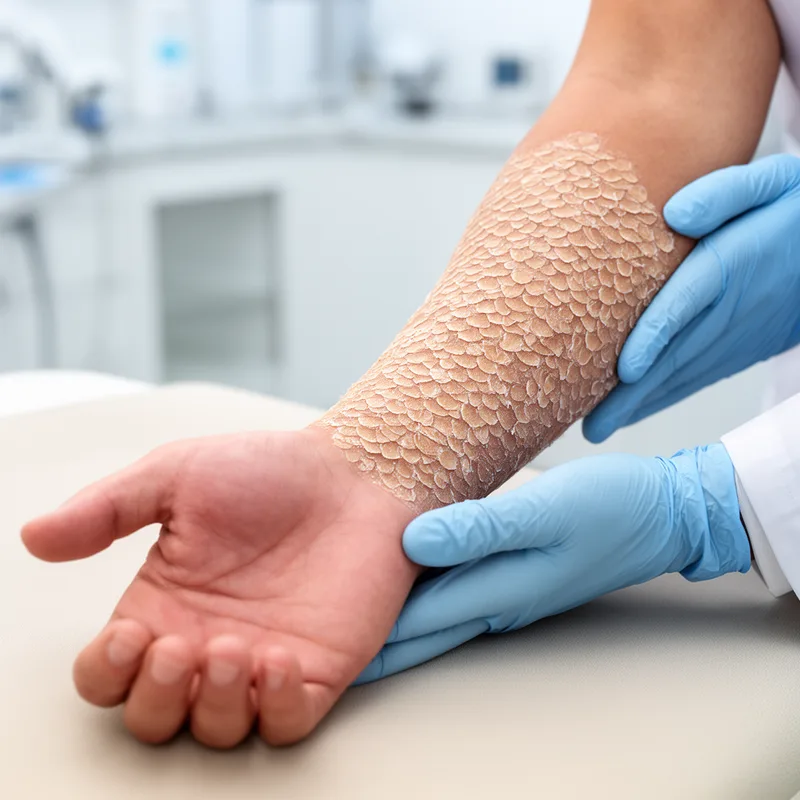
ichthyosis
 1
9.9

- noun
- /ɪkˈθaɪoʊsɪs/
- Specialized
- People with ichthyosis often face challenges with dry skin that can lead to discomfort and require specialized skincare routines.
- ichthyosis vulgaris
Examples
-
So in that regard, we have been luckier than some of our friends with ichthyosis who struggle with chronic skin infections.
Blog text (28) -
If patchiness persists after moisturizing, it could be indicative of a skin condition such as eczema or ichthyosis.
-
There was a discussion on Facebook earlier about whether folks with ichthyosis needed any special storm preparations.
Blog text (28) -
It is the most common form of ichthyosis, accounting for more than 95% of cases.
Academic text (2007) -
Ichthyosis vulgaris can be further classified into hereditary and acquired forms.
Academic text (2007) -
The term ichthyosis is derived from the ancient Greek root ichthys, meaning fish, and describes the resemblance of the affected skin to fish scales.
Academic text (2007) -
Hereditary ichthyosis vulgaris is an autosomal dominant genetic disorder first evident in early childhood.
Academic text (2007) -
The dermatologist explained that ichthyosis is characterized by the accumulation of scales on the skin, which is a result of a genetic disorder.
Surface Forms
Morphology
ichthyosis = ichthyo (opaque) = ichthy + osis
The term is built from the Greek combining form ichthy- ('fish') + the medical suffix -osis, but the combining form is obscure to most learners so the meaning cannot be derived by a B1 learner from common English vocabulary.
Etymology
The word ichthyosis comes from the Greek root ichthys meaning 'fish' and the ending -osis meaning 'condition'. The skin in ichthyosis becomes dry and scaly like fish scales, so the name helps you remember what the condition looks like.