
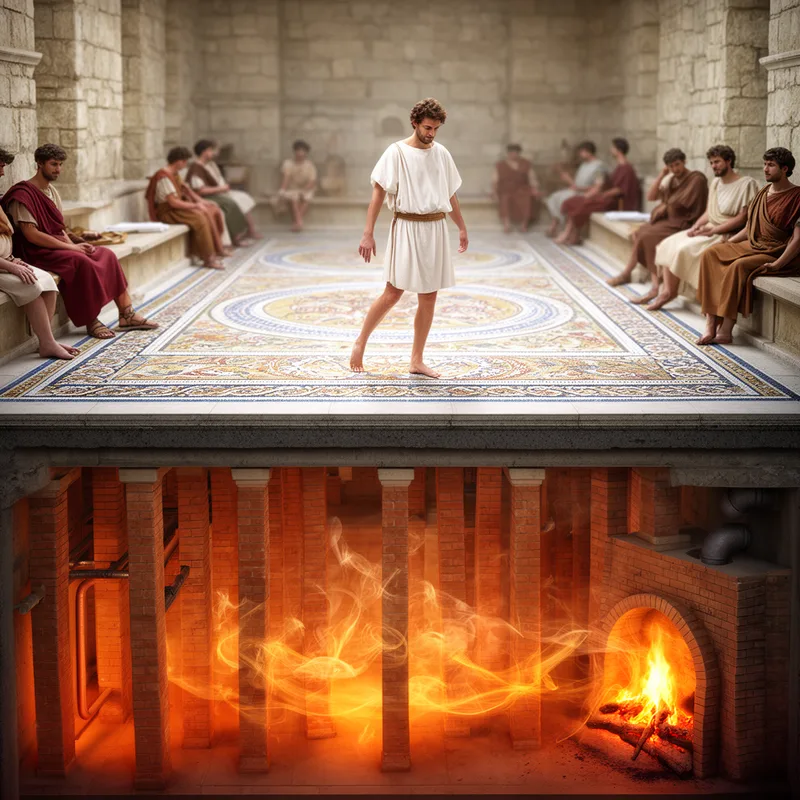
hypocaust


 1
9.9
- noun
- /ˈhaɪpəˌkɔst/
- Archaic
- When the dark spot and the carbon in the hypocaust furnace were analyzed and carbon dated (C14), the archaeologists and their team were able to determine that the dark spot was a campfire built by the great-great-grandkids of the owners of the intact villa with a working central heating system.
Examples
-
In ancient villas, the hypocaust provided efficient heating by circulating hot air beneath the floors.
-
And from there, proceed directly to the hypocaust.
-
The building was a villa built some short time after the conquest, complete with central heating (a well-designed hypocaust).
Blog text (19) -
PHOTO (COLOR): A hypocaust used to heat water for the baths at a Roman villa dates to the mid-1st century.
Academic text (2006) -
The Romans used the hypocaust system to keep their public baths warm and comfortable.
-
The archaeologist explained how the hypocaust heated the entire room, making winter evenings much cozier.
Synonyms
 104
1.0
A system that makes a building or room warm
 63
1.0
The system that gives warmth to a building
 12
2.8
A system that warms a building by moving hot air or water
 1
3.7
A system in a building that makes warm air and sends it to rooms
Surface Forms
Morphology
hypocaust = hypo + caust
This is a classical Greek formation meaning roughly 'under-burn', but the specific Roman heating-system sense is not recoverable for most learners from the constituent parts.
Etymology
Hypocaust comes from the Greek parts hypo- 'under' and caust 'to burn', and you can see hypo- in hypothermia and caust in caustic. So hypocaust literally means 'under-burning', which describes the Roman system that sent hot air under the floor to warm rooms.