
hyperplane


 1
9.9
- noun
- /ˈhaɪpərˌpleɪn/
- Specialized
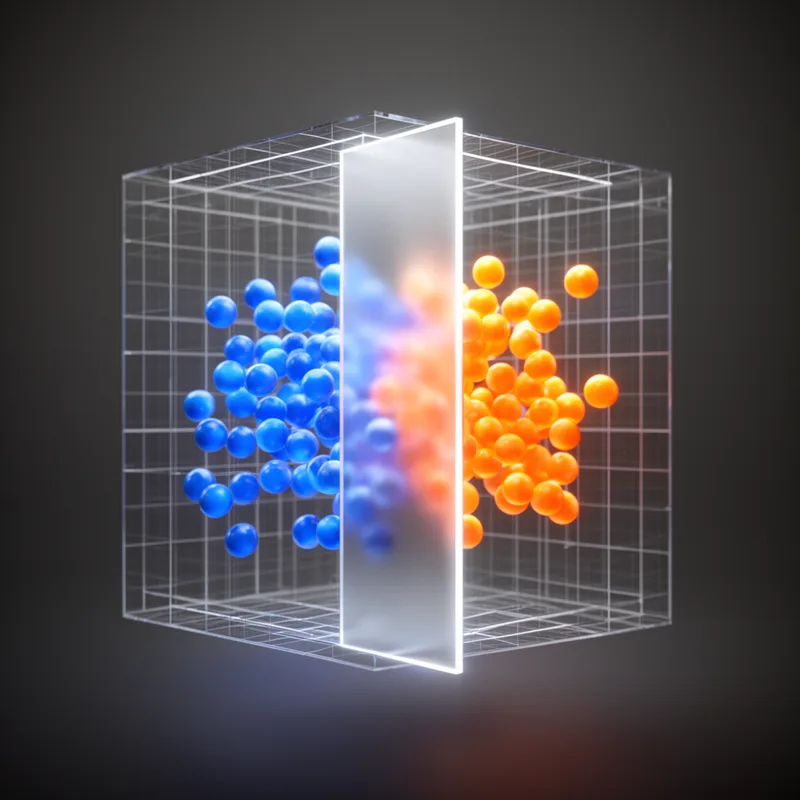
- In three-dimensional space, a hyperplane is a flat surface that divides the space into two half-spaces.
Examples
-
The objective is to find the best hyperplane that stratifies the two classes with the largest margin.
Academic text (2016) -
So you have these linear constraints that turns out to define hyperplanes in N dimensions.
-
This would be a hyperplane in in three space.
-
Now restrict to this hyperplane and ask yourself the same question.
-
The optimal solution was taken to be that in which the number of variables in the 0.1 hyperplane was maximized.
Academic text (1990) -
It involves the fitting of a few hyperplanes to scatter points.
Academic text (1992) -
This margin defines the maximal width of the two slabs parallel to the hyperplane that have no interior data points.
Academic text (2016) -
The algorithm's goal is to determine the optimal hyperplane that separates the data points into distinct classes.
-
To visualize complex data, we often project it onto a lower dimension by using a hyperplane.
Surface Forms
Morphology
Etymology
The word hyperplane joins the first part hyper- meaning 'over' or 'beyond' and plane meaning a flat surface, like the familiar word 'plane' for a flat area. So, a hyperplane is like a flat sheet that sits in a space with more dimensions and is one dimension smaller than the space around it.