
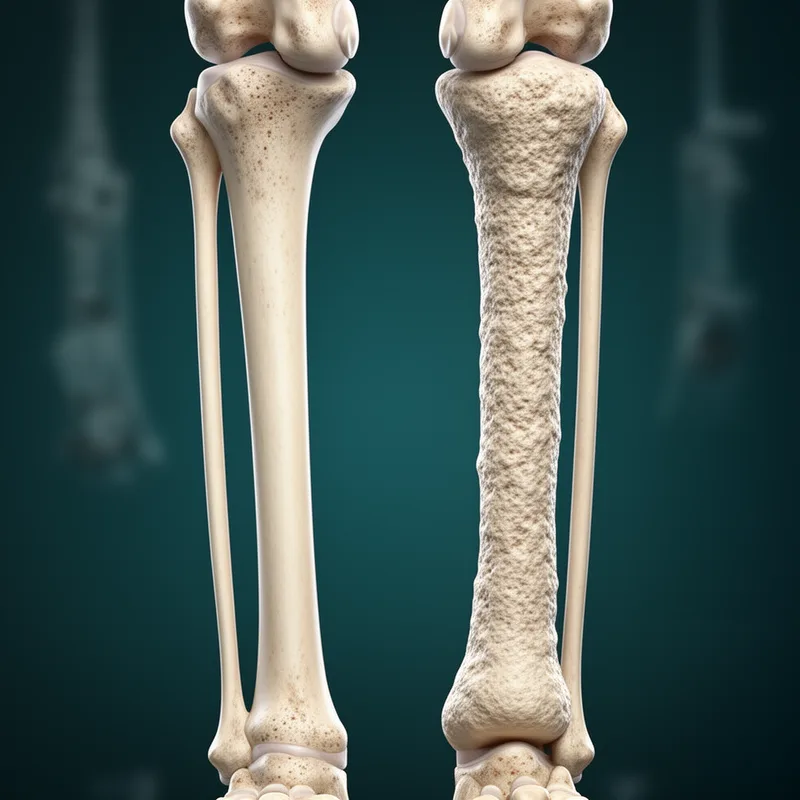
hyperostosis


 1
9.9
1
9.9
- noun
- /ˌhaɪpəroʊˈstoʊsɪs/
- Specialized
- Studies show that hyperostosis may complicate surgical procedures due to the increased bone volume.
- skeletal hyperostosis
- idiopathic skeletal hyperostosis
- diffuse skeletal hyperostosis
Examples
-
According to anatomists who exhumed his bones, the procedure caused hyperostosis frontalis interna, or a thickening of the cranial vault, usually associated with postmenopausal women, that can cause behavioral and psychiatric issues.
Academic text (2011) -
Right-sided frontal hyperostosis could not be ruled out in the differential diagnosis.
Academic text (2006) -
Figures 1 to 8 show diffuse skeletal hyperostosis about several joints.
Academic text (2004) -
They frequently produce hyperostosis and bone thickening, but usually without the bone erosion that glomus jugulare tumors display.
Academic text (2009) -
Diffuse idiopathic skeletal hyperostosis (DISH) is a disease entity that was first described by Forestier and Rotes-Querol in 1950.
Academic text (2004) -
The presentation of DISH, on initial inspection, appears to have characteristics similar to OA. However, the hyperostosis that occurs with DISH does not cause degenerative processes within a joint, nor does it involve vertebral disc collapse, sclerosis, and joint space narrowing of the spine.
Academic text (2004) -
The doctor explained that hyperostosis can lead to painful joint stiffness and reduced mobility.
-
In veterinary medicine, hyperostosis is commonly observed in certain dog breeds, often resulting in bone deformities.
How Bone-Forming
- Specialized
1
9.9

- Specialized
3
7.4
Surface Forms
Morphology
hyperostosis = hyper + ost + osis
Although the term is formally analyzable as hyper- + ost- + -osis, its medical combining forms are unlikely to be known by an average B1 learner.
Etymology
Hyperostosis breaks into hyper- 'over', osteo- 'bone', and -osis 'condition', so it literally means a condition of 'too much bone'. That's why hyperostosis refers to an abnormal thickening or extra growth of bone tissue.