

hyperon
- noun
- /ˈhaɪpərɒn/
- Specialized
- In experimental physics, researchers are studying hyperons to understand the strong force better.
Examples
-
The decay patterns of hyperons provide valuable insights into the behavior of fundamental particles.
-
Hyperons are created in particle collisions where conditions are extreme and typically short-lived.
-
What are the little pieces that are bound tightly inside protons, neutrons, hyperons, and all the rest?
Compounds
- Specialized
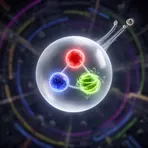
A tiny neutral particle made of three quarks that contains a strange quark
Surface Forms
Morphology
hyperon = hyper + on
Although the scientific term contains the recognizable combining form hyper-, the specialized meaning 'subatomic particle' is not compositionally predictable for an average learner.
Etymology
Hyperon comes from the Greek beginning hyper- meaning 'over' or 'beyond' and the particle ending -on, which you see in names like proton and electron. So a hyperon is literally a particle 'beyond' the usual nucleons, which fits because it is heavier than a neutron and not a normal part of an atomic nucleus.

