

hypercoagulability


 1
9.9
1
9.9
- noun
- /ˌhaɪpərkoʊˌɔːɡjʊˈlæbɪlɪti/
- Specialized
 :
hipercoagulabilidad
:
hipercoagulabilidad
- The presence of hypercoagulability increases the risk of thrombosis in certain patients.
Examples
-
Breast cancer is probably a predisposing factor for hypercoagulability.
Academic text (2007) -
Screening tests for hypercoagulability were normal except for positive antiphospholipid antibodies.
Academic text (2007) -
The study of hypercoagulability status was normal.
Blog text (30) -
But even rarer conditions exist, such as the recently discovered combination of vasculitis and hypercoagulability.
Academic text (2007) -
Malignant disease is an independent predisposing factor for hypercoagulability.
Academic text (2007) -
Breast cancer and the use of tamoxifen have already been suspected for hypercoagulability abnormalities and thrombi formation.
Academic text (2007) -
Screening tests for hypercoagulability included normal levels of serum fibrinogen, d-dimers, protein C and S, antithrombin III, but positive antiphospholipid antibodies.
Academic text (2007) -
In addition to endothelial dysfunction and hypercoagulability, flow turbulence is an essential part of Virchow's triad and must be minimized to prevent anastomotic thrombosis (2).
Academic text (2015) -
A patient with hypercoagulability may experience frequent blood clots.
-
Doctors often test for hypercoagulability in patients with unexplained vein issues.
Synonyms
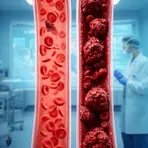
A condition in which blood forms clots more easily
Surface Forms
Morphology
hypercoagulability = hypercoagulable (semi-transparent) = hyper + coagul + able + ity
The noun is a regular -ity derivation from the adjective hypercoagulable.
Etymology
The word hypercoagulability breaks into three parts: hyper- 'too much', coagul- 'to clot', seen in coagulate, and -ability 'state of'. So, it describes a state where the blood is 'too likely to form clots'.