
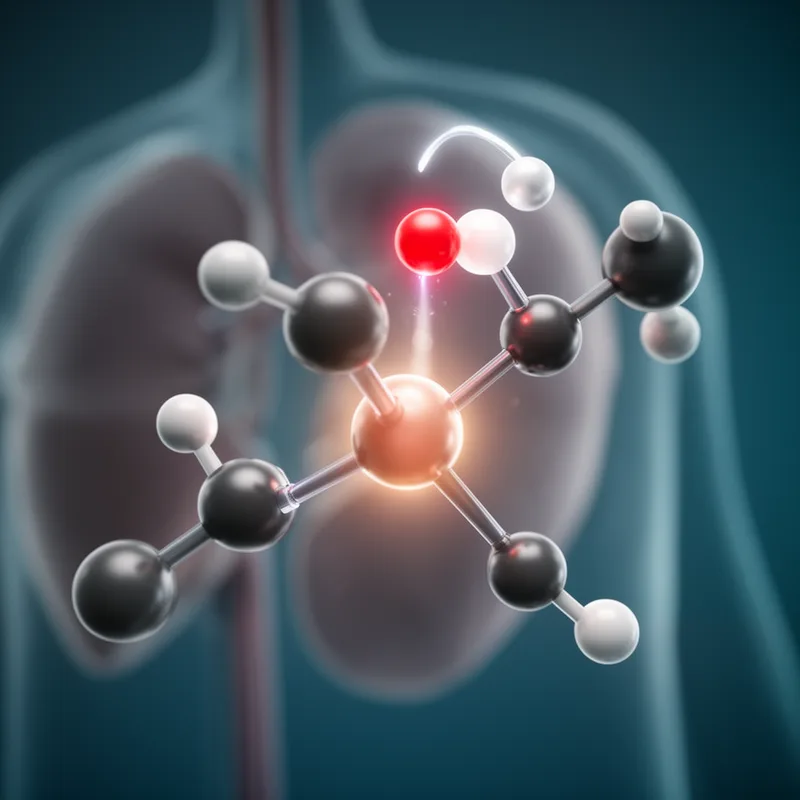
hydroxylation


 1
7.5
- noun
- /haɪˌdrɒk.sɪˈleɪ.ʃən/
- Specialized
- The process of hydroxylation occurs when a hydroxyl group is added to the molecule, altering its chemical properties.
- hydroxylation by MMO
Examples
-
Abnormal hydroxylation of proline in bone collagen also has been demonstrated (8).
Academic text (1997) -
Inhibitors of cytochrome P450 1A were found to suppress the hydroxylation of glutamate in experiments with human liver microsomes.
Academic text (2000) -
Thus, the results presented above show that the MMO-catalyzed methane hydroxylation reaction proceeds via a bound-radical mechanism through the rate-determining H abstraction transition state.
Academic text (2001) -
In other words, during the hydrocarbon hydroxylation reaction by MMO, one may expect spin-crossing of the system and switching between antiferromagnetic and ferromagnetic couplings among the expected intermediates and transition states.
Academic text (2001) -
Researchers studied the hydroxylation of specific amino acids to understand its effects on protein structure.
-
In biochemistry, hydroxylation is a crucial reaction that modifies the activity of several important compounds.
Surface Forms
Morphology
hydroxylation = hydroxylate (opaque) = hydroxyl + ate + ion
The word is built by regular chemical suffixation, but both the base verb and the resulting noun are specialist technical vocabulary rather than something an average learner can infer confidently.
Etymology
Hydroxylation comes from hydro- meaning 'water' and hydroxyl meaning the small 'OH' group, like a tiny piece of water made of oxygen and hydrogen. So hydroxylation is the act of adding that 'OH' piece to a molecule, which is exactly the chemical process the word names.