
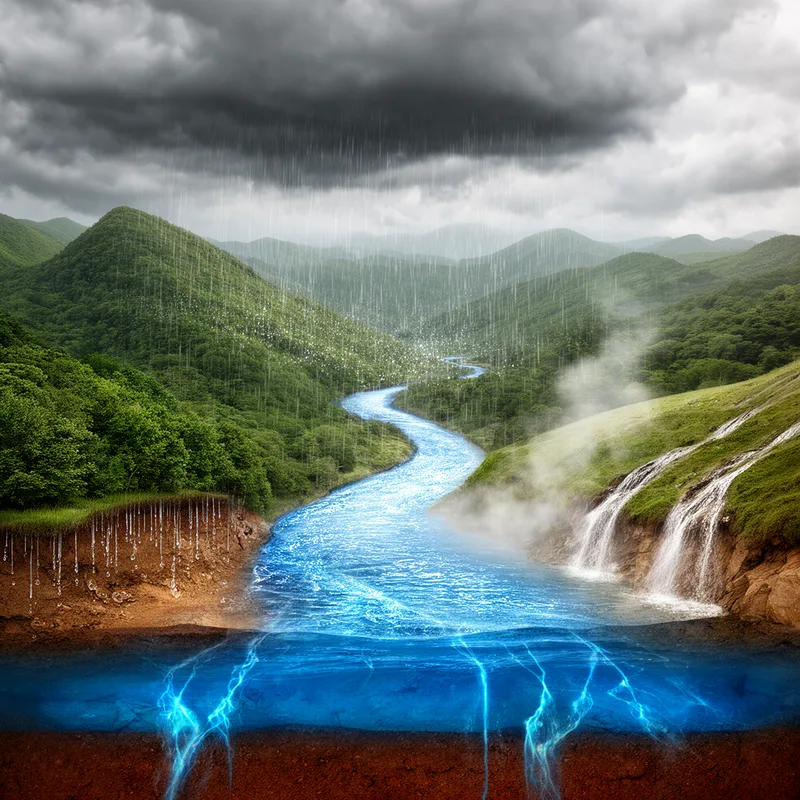
hydrologic
 1
6.8

- adjective
- /haɪˈdrɒlədʒɪk/
- Specialized
- Understanding hydrologic processes is vital for effective water resource management.
- hydrologic cycle
- hydrologic changes
- hydrologic conditions
Examples
-
Land uses such as dams, dikes, urbanization, and logging are known to affect the hydrologic cycle, in part by altering flow regimes.
Academic text (2002) -
Failure was generally associated with improper hydrologic conditions in the new wetlands.
Academic text (1998) -
Ideally, the broader scale monitoring programs provide a hydrologic context for the design of such studies.
Academic text (2006) -
The other is that the relationship holds only if hydrologic conditions are also distributed systematically.
Academic text (1997) -
The difference between the patterns in the two watersheds can largely be explained by an examination of hydrologic conditions.
Academic text (1997) -
To restore the Florida Everglades, it is essential to understand how different hydrologic schemes will affect key species of animals.
Academic text (2001) -
Mexico City is located in an originally closed hydrologic basin, which was artificially opened in the early 1600s.
Academic text (1997) -
In the 1990s, hydrologic investigations were conducted to determine whether groundwater could have met domestic and agricultural needs.
Academic text (2000) -
Altering the albedo of the Earth would also affect atmospheric circulation, rainfall, and other aspects of the hydrologic cycle.
Academic text (2009) -
Such replacement disturbs the terrestrial portion of the hydrologic cycle and the pattern of groundwater movements in particular.
Academic text (1990)
Synonyms
 4
6.7
About how water moves and where it is in nature
Surface Forms
Morphology
hydrologic = hydrology (semi-transparent) = hydro + log + y + ic
Adding -ic to hydrology is a standard adjective-forming step.
Etymology
The word hydrologic comes from the Greek parts hydro- meaning 'water' and -logy meaning 'study', as you can see in hydrogen or hydrant. So hydrologic means 'about the movement or study of water', which is why scientists use it for rivers, rainfall, and floods.