

hydrogen bomb
 8
4.9
8
4.9

- noun
- /ˈhaɪdrədʒən bɑm/
- Specialized
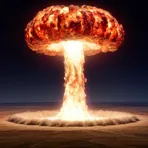
- On March 1, 1954, the United States detonated a seventeen-megaton hydrogen bomb at Bikini Atoll in the Pacific Ocean.
- hydrogen bomb test
Loading YouTube…
Watch on YouTubeSo if you're going to have a hydrogen bomb, you better be wise enough to wield it.
- So if you're going to have a hydrogen bomb, you better be wise enough to wield it.
- So, you know, Teller and Ulam gave us the hydrogen bomb.
- We're talking about a nuclear confrontation with both sides having hydrogen bombs.
- Would it be on the scale of like roughly dozens of hydrogen bombs?
- So this is almost in the range of the biggest hydrogen bomb that the US Department of Defense ever tested, right?
- And you, you don't need to be a PhD marine biologist to know to save the whales or you don't need to be a nuclear physicist to want to stop hydrogen bombs.
Examples
-
The United States detonated a hydrogen bomb above Johnston Island in the South Pacific.
-
The stakes were extremely high; the United States tested a hydrogen bomb in 1952, and the Soviet Union did the same a year later.
Academic text (2002) -
However, a third hydrogen bomb remains lost at sea.
-
The question before us is this: Should the hydrogen bomb be built?
-
So this is almost in the range of the biggest hydrogen bomb that the US Department of Defense ever tested, right?
-
What we did not know was that the Soviet Union had initiated the development of the hydrogen bomb a full three months earlier.
Academic text (1990) -
At 8 a.m. This morning, the United States detonated a hydrogen bomb above Johnston Island in the South Pacific.
-
Between 1946 and 1958, the United States detonated sixty-six atomic and hydrogen bombs on Bikini and Enewetok atolls in the Pacific.
Academic text (1990) -
In 1953, the Soviet Union conducted a secret test of its first hydrogen bomb.
-
North Korea tested what it said was a hydrogen bomb in September 2017.
Synonyms
 634
3.5
634
3.5
A very powerful bomb that uses energy from splitting or joining atoms
 148
7.6
148
7.6
A very powerful bomb that uses nuclear energy
 35
5.0
35
5.0
A part of a missile or bomb that contains a nuclear bomb
 3
4.0
3
4.0
A very powerful nuclear weapon that explodes by joining hydrogen atoms
 1
6.3
1
6.3
A weapon that makes a very large explosion by joining light atoms like hydrogen
 1
7.4
1
7.4
A bomb put on a missile that uses nuclear energy to make a very large explosion


 1
6.9
1
6.9
A very powerful weapon that makes a huge explosion by joining tiny hydrogen atoms at extreme heat
 1
7.5
1
7.5
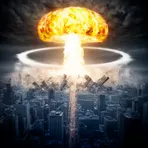
A very powerful bomb that can destroy a whole city, often using nuclear energy
How Destructive

Surface Forms
Morphology
The compound combines 'hydrogen' (a chemical element) and 'bomb' (an explosive device), so a learner who knows both words can infer it is a bomb that involves hydrogen and therefore a very powerful/advanced type of bomb. Although the precise technical mechanism (nuclear fusion) is specialized, the overall meaning is directly derivable from the constituents and mirrored across many languages.
Etymology
Hydrogen bomb is named for how it makes a huge explosion: tiny atoms of hydrogen are forced to join and become helium, and that joining releases a very large amount of energy. That's why the name pairs hydrogen with a very powerful bomb.