
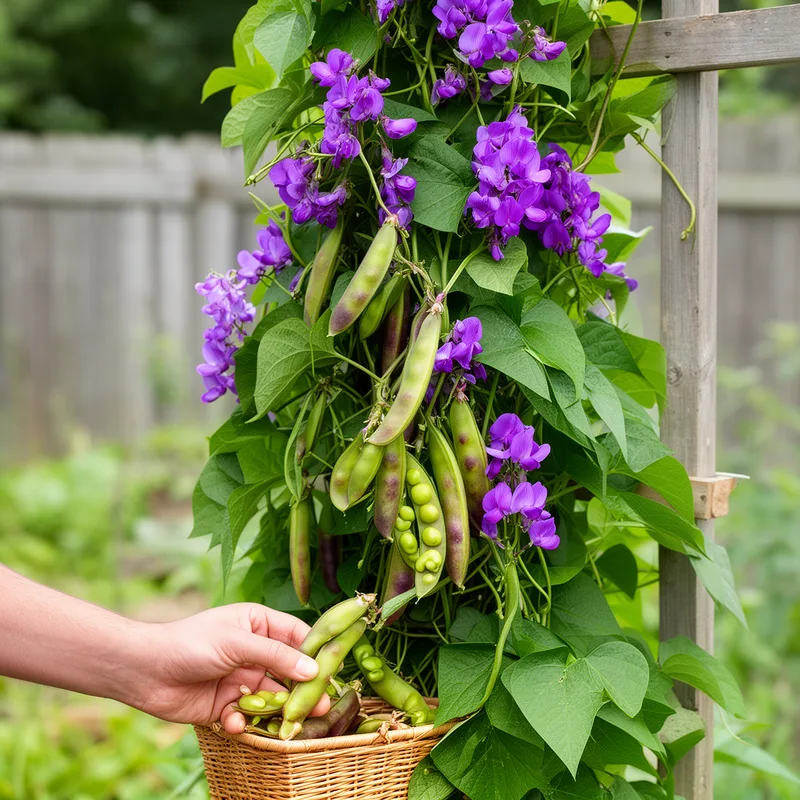
hyacinth bean
- noun
- /ˈhaɪəsɪnθ biːn/
- Indian
- The hyacinth bean produces beautiful purple flowers.
Examples
-
They planted hyacinth bean vines along the garden fence for their beautiful flowers and decorative pods.
-
The gardener decided to grow hyacinth bean for its beautiful purple flowers and tasty seeds.
-
A single hyacinth bean plant can quickly cover a trellis with its lush, leafy vines.
-
The young pods of the hyacinth bean are often cooked and eaten as a vegetable in Indian cuisine.
-
Many gardeners love hyacinth beans for their fragrance.
-
In the summer, hyacinth bean vines can add vibrant colors to your garden while providing edible pods.
-
She enjoyed cooking with the fresh seeds from the hyacinth bean plant, which she harvested from her backyard.
Synonyms
A tropical plant with purple flowers that makes edible beans for people and animals
A climbing plant with fragrant purple flowers and maroon edible pods often grown as a garden plant and vegetable

A climbing plant with purple flowers and dark red pods that contain edible beans and is grown in gardens

A climbing plant with three-part leaves, purple pea-like flowers, and seeds in dark red pods
A climbing plant with purple flowers and dark red pods containing edible seeds

A climbing plant with purple flowers and dark red pods that have edible seeds and are used as a vegetable
How Edible
- Indian
 1
1.0
1
1.0


- Indian
Surface Forms
Morphology
This is a directly compositional noun: 'hyacinth' (a flowering plant) + 'bean' (an edible seed/plant) yields a type of bean/plant associated with hyacinth-like flowers. A B1 learner who knows both constituent words can readily infer it denotes a plant/bean with showy/fragrant flowers rather than an idiomatic or unpredictable meaning, so it is transparent.
Etymology
Hyacinth bean may come from the plant's deep purple flowers that look like a hyacinth and from its edible bean pods. So the name simply describes a 'bean' plant known for its hyacinth-coloured flowers.