
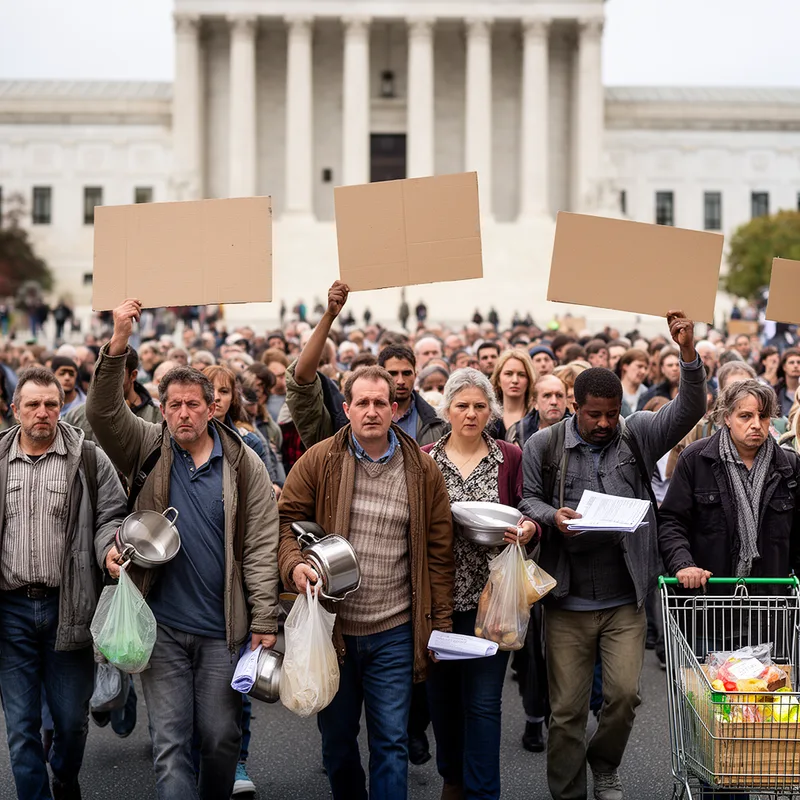
hunger march
- noun
- /ˈhʌŋɡər mɑrtʃ/
- Archaic
- In 1931, he helped organize a National Hunger March on Washington.
Examples
-
The hunger march aimed to raise awareness about poverty and unemployment in the community.
-
Radical moods are on the rise, hunger marches and strikes are increasing and the far left and far right are growing in strength.
-
Maybe Joey was right; maybe the guy was a spy trying to find out about the Hunger March.
Fiction book (1999) -
In 1932, one of the five victims of police violence during the Ford Hunger March was Joe DeBlasio, an IWO Junior.
Academic text (1995) -
His new story, however, is a work of science fiction, not fantasy: it applies quantum mechanics to the city of assembly lines, mixes in real events like the Hunger March, and voilà!
Fiction book (1999) -
In 1931, he helped organize a National Hunger March on Washington to demand jobs for the unemployed.
-
Laid-off workers held a hunger march in 1932 to protest against their lack of support from the government.
Synonyms
 161
2.6
161
2.6

A public walk for people to show support or protest for a cause
 5
3.4
5
3.4
A public walk by many people to show they disagree and ask for change
How Big

Surface Forms
Morphology
The meaning 'a protest march related to hunger or poverty' is directly derivable from combining 'hunger' (lack of food/need) with 'march' (an organized protest procession). This topic + event compounding is common cross-linguistically, so a B1 learner who knows both constituents will very likely infer the intended meaning.
Etymology
Hunger march comes from a simple image: people with hunger walking together in a march to show they needed food and jobs. So today it means 'a protest by people without work who ask for food, jobs, or help'.