

house wren
- noun
- /haʊs rɛn/
- US
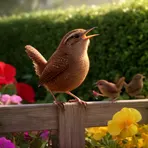
- The cheerful song of the house wren fills the air as it flits through the bushes.
Examples
-
Not all birds, however, are as fixed in their diet as the house wren.
Academic text (1993) -
PHOTO (COLOR): A house wren plucks an arthropod from tree bark.
Academic text (1993) -
I heard a yellow warbler, a house wren, a red-eyed vireo; stray notes of goldfinch.
Fiction book (1991) -
In the eastern United States, house wrens generally spend the winter in Virginia, Tennessee, Arkansas, and points south, where the average minimum daily temperature ranges from 30 to 50°F.
Academic text (1993) -
My studies of house wrens, conducted with my colleague Cheryl Dykstra, illustrate how even insect-eating birds sometimes can collect food much faster than they can digest it.
Academic text (1993) -
House wrens are small (10-gram) brown birds that feed entirely on grasshoppers, beetles, caterpillars, bugs, and spiders they collect from the ground, trees, and shrubs.
Academic text (1993) -
The house wren is a small bird often heard singing near gardens and homes.
-
You can often find a house wren nesting in the eaves of a house during the summer.
Synonyms
 5
2.2
5
2.2

A small active brown bird that sings and lives near gardens
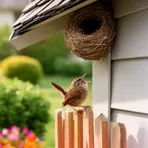
A small North American songbird that often nests near houses
Surface Forms
Morphology
The compound 'house wren' is compositionally transparent: 'house' specifies the habitat and 'wren' names the bird, so the meaning 'a wren associated with houses or human dwellings' follows directly from its parts. This head-modifier pattern is common in English and cross-linguistically, so a B1 learner who knows both constituents can infer the meaning without prior exposure.
Etymology
House wren may come from the bird's habit of nesting close to people's homes. Because a wren often builds a nest in a house, on a porch or in a mailbox, the name came to mean this small songbird that likes being near houses.