

hour angle
- noun
- /ˈaʊər ˈeɪŋɡəl/
- Specialized
- Astronomers measure the hour angle to find the exact position of stars in the night sky.
Examples
-
The hour angle helps astronomers predict when a specific star will be visible at a given location.
-
The outer movable disk with the lunar symbol on the pointer represents the hour angle of the Moon, whereas the inner movable disk with the solar symbol on the pointer determines the hour angle of the Sun.
Academic text (2005) -
The outer movable disk with the lunar symbol on the pointer represents the hour angle of the Moon, whereas the inner movable disk with the solar symbol on the pointer determines the hour angle of the Sun.
Academic text (2005) -
To navigate accurately, sailors calculate the hour angle of various celestial bodies.
Synonyms
 2
9.9
2
9.9

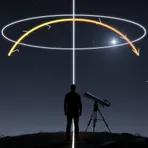
The angle measured west along the sky's equator from the local north–south line to a star
Surface Forms
Morphology
The compound clearly links 'hour' (a time unit) with 'angle' (a geometric measure), so a learner could infer it denotes some kind of angular measure related to time — giving a partial intuitive sense. However, the precise astronomical meaning (angle measured along the celestial equator from the observer's meridian to an object) is technical and not deducible from the constituents by a B1 learner without domain knowledge, so it is only partially transparent.
Etymology
Hour angle comes from old sky watchers who used time to measure the turning sky: they treated the sky like a big 'clock', so the word hour points to time and angle to the turn they measured. That's why hour angle shows how many 'hours' a star is away from the observer's middle line and helps say when it will be seen.