
horned owl
 1
4.2
1
4.2

- noun
- /hɔrnɪd aʊl/
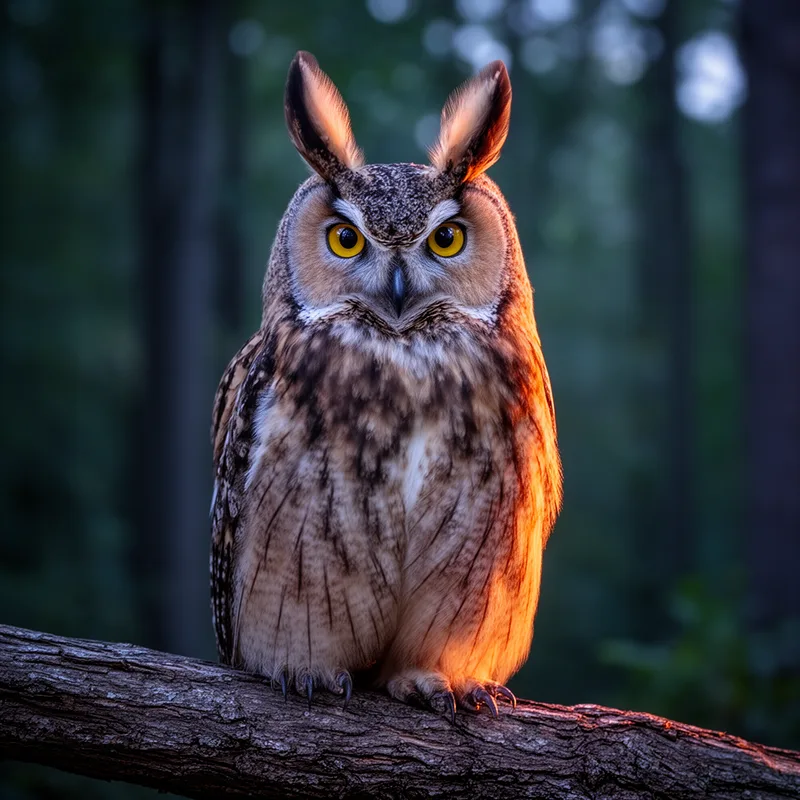
- The great horned owl is known for its distinctive tufts that resemble horns.
- the great horned owl
Loading YouTube…
Watch on YouTubeThe unlikely silhouette of a common horned owl with sharp, sharp tufted ears, rust brown face with white feathers, and chin and throat mottled Gray and brown body.
- The unlikely silhouette of a common horned owl with sharp, sharp tufted ears, rust brown face with white feathers, and chin and throat mottled Gray and brown body.
Examples
-
At dusk, you can often hear the call of a great horned owl echoing through the forest.
-
Great horned owls are versatile predators, often hunting at night to catch their prey.
-
From its broad wings, short tail, and large size, I was pretty certain it was a great horned owl.
Blog text (18) -
If it is the great horned owl, he can probably see you from his perch, and is telling the night how beautiful you are.
-
Plenty of critters kill house cats, from great horned owls to dogs.
Fiction book (1998) -
With the current high numbers of varying hares on the peninsula, great horned owls have probably been feeding well for the past couple of years.
Blog text (18) -
I was astonished to meet the wide-eyed gaze of a great horned owl.
Fiction book (2002) -
While that is just a story, great horned owls are actually the only known avian predators of skunks.
Blog text (18) -
Great horned owls are also a major predator of young raptors, like ospreys.
Blog text (18) -
Great horned owls are beautifully camouflaged with mixtures of brown, gray, and black mottling.
Blog text (18)
Synonyms
 210
1.0
210
1.0
A night bird with big eyes that face forward and a round head
 1
4.0
1
4.0
A large owl with ear tufts and brown and white feathers found in North America
 1
9.9
1
9.9
A group of large owls like horned or eagle owls that live on many continents

A large brown owl with ear tufts and a deep hoot
Surface Forms
Morphology
The phrase is compositionally transparent: 'horned' describes having horn-like structures and 'owl' names the bird, so a 'horned owl' is simply an owl with horns or horn-like tufts. This follows a regular adjective + noun pattern found cross-linguistically, so a B1 learner who knows both constituents would readily infer the meaning.
Etymology
Horned owl comes from the bird's head feathers: the word horned refers to two upright feather tufts that look like 'horns' or 'ears', and owl is the bird. So, the name means an owl with horn-like feather tufts, not real horns.