
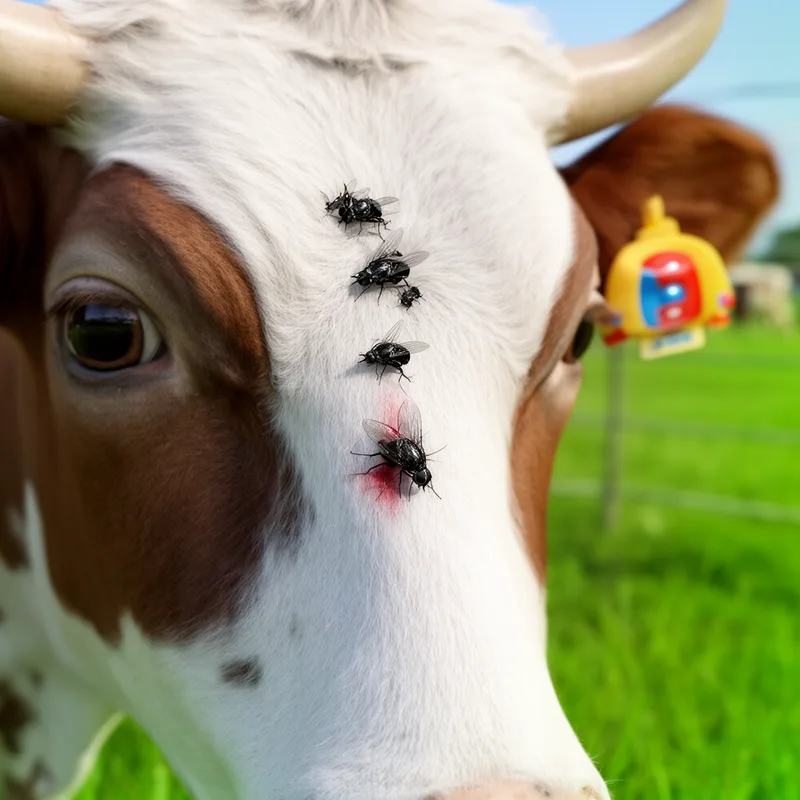
horn fly
- noun
- /hɔrn flaɪ/
- Specialized
- PHOTO (COLOR): Horn flies, Haematobia irritans. (K7265-11)
Examples
-
PHOTO (COLOR): Insecticidal eartags work much like tick and flea collars for pets to provide long-lasting control of horn flies. (K7264-7)
Academic text (1996) -
The first eartags held organophosphates that were effective against horn flies for 6 to 10 weeks.
Academic text (1996) -
He conducted control studies on the stable fly and horn fly at the newly opened Kerrville facility.
Academic text (1996) -
Miller also demonstrated that a pour-on avermectin-based insecticide can provide 35 days of horn fly control when applied to cattle during spring roundups.
Academic text (1996) -
Because the eartags were so popular with producers and used so extensively on cattle, less-susceptible horn flies eventually became resistant to the tags' pesticides, says Kunz.
Academic text (1996) -
The cattle were constantly bothered by horn flies, which gathered around their ears and horns.
-
Farmers often use insecticides to control the population of horn flies on their livestock.
-
During the summer months, horn flies can cause significant stress to cattle if not managed properly.
Synonyms
A small dark fly that bites cows near their horns
Surface Forms
Morphology
The compound 'horn fly' is transparently built from 'horn' + 'fly' and directly signals a type of fly associated with horns (i.e., a fly found on/near animal horns). Although it refers to a specific pest species and behavior, that specific meaning is a natural extension of the constituents and would be inferable by a B1 learner who knows both words.
Etymology
Horn fly comes from a simple image: tiny flies gather and suck blood near the base of a cow's horns. So the name means 'a small fly that lives on cattle and feeds on their blood'.

