
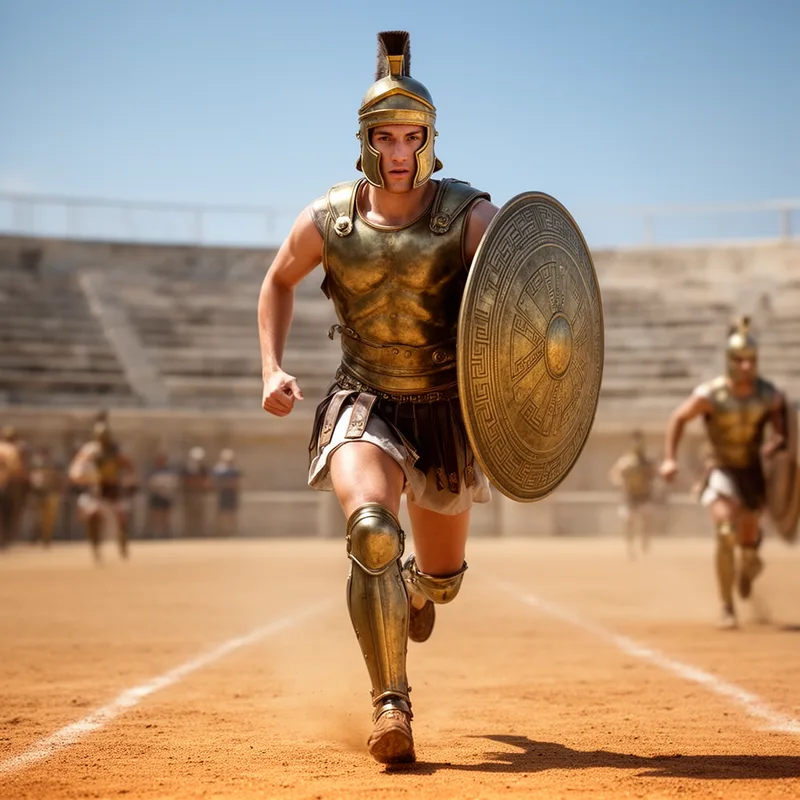
hoplitodromos
- noun
- /hɑːˌplɪtəˈdroʊməs/
- The hoplitodromos trained daily to build the strength needed to run in heavy armor.
Examples
-
In ancient Greece, a hoplitodromos had to wear heavy armor.
-
During the festival, the fastest hoplitodromos was celebrated as a hero in his city.
-
Historians study the role of the hoplitodromos in ancient Greek athletic competitions.
-
The hoplitodromos sprinted across the finish line.
-
The hoplitodromos demonstrated exceptional skill as he raced while wearing full armor and carrying a shield.
-
In the ancient Greek games, each hoplitodromos ran with the heavy burden of armor to test their endurance.
-
Winning the race made the hoplitodromos famous, as it showcased not only speed but also the ability to run in armor.
Surface Forms
Etymology
Hoplitodromos comes from Greek parts hoplit- (from hoplon, 'shield' or 'weapon', seen in the word hoplite for a soldier) and -dromos ('running' or 'race'). So a hoplitodromos was a runner who ran in armor and with a shield, which explains the modern meaning of a competitor in that heavy-armor footrace.

