
homotopic


 1
9.9
- adjective
- /ˌhoʊməˈtɑpɪk/
- Specialized
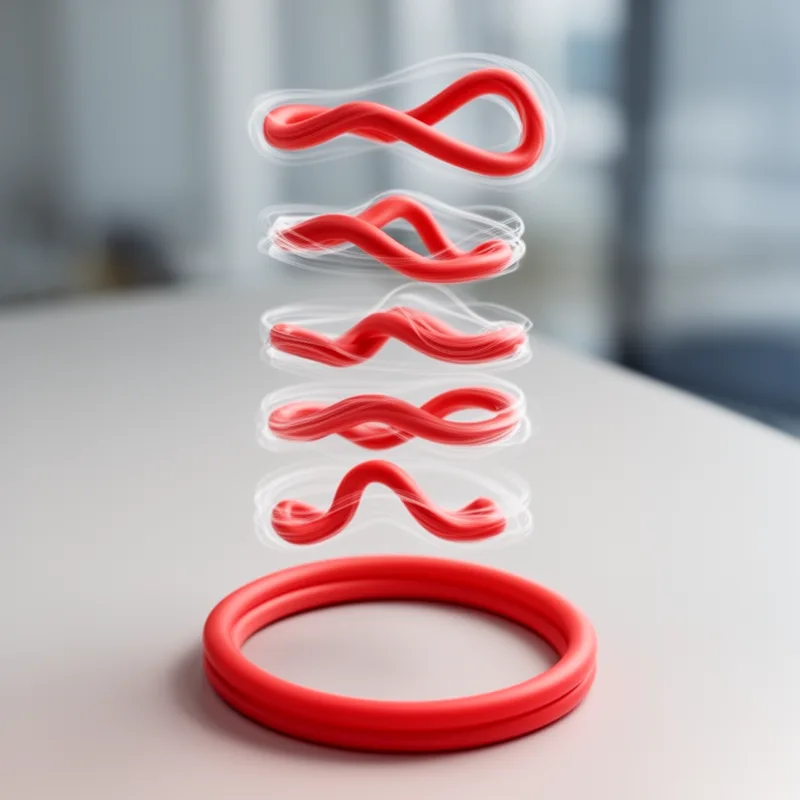
- In topology, continuous functions that can be deformed into each other are described as homotopic.
- homotopic inhibition
- homotopic callosal
Examples
-
If two paths can be continuously transformed into one another without leaving a defined space, they are said to be homotopic.
-
So that will give the the two faces, front and back are homotopic, they're the same.
-
However, the essence of his idea lies in the notion of a homotopic inhibitory mechanism of callosal interaction between the hemispheres.
Academic text (2002) -
The model develops the notion of homotopic callosal inhibition to account for differential specialization of the hemispheres for detail and context in language processing.
Academic text (2002) -
Cook (1986) has argued that structural asymmetries between the hemispheres are relatively minor, and that functional asymmetries are largely generated through homotopic inhibition.
Academic text (2002) -
The model employs the neurophysiological mechanism of homotopic callosal inhibition to explain recent findings, which suggest that the left hemisphere processes denotative meaning, while the right hemisphere specializes in connotative meaning.
Academic text (2002) -
This permits the posited asymmetrical flow of processing to commence, in which inhibitory influences first affect the surrounding areas in the left hemisphere and the homotopic areas of the right hemisphere, followed by disinhibition of the neural space around the homotopic areas in the right hemisphere.
Academic text (2002) -
Two shapes are considered homotopic if one can be transformed into the other without breaking or tearing.
Surface Forms
Morphology
homotopic = homotopy (opaque) = homo + topo + ic
The adjective is formed by the regular suffixation of -ic to the noun 'homotopy', a standard adjectival derivation.
Etymology
Homotopic comes from Greek parts homo- meaning 'same' and topo- meaning 'place', the same parts you see in topography. So in the math of shapes and spaces, homotopic describes two paths or shapes you can move into each other without cutting or tearing, which is why they are seen as 'the same' in shape.