

homolog
 1
8.1
1
8.1

- noun
- /ˈhɒməˌlɔg/
- Specialized
 :
homólogo
:
homólogo
- There are hardly any distinguishing features in homolog sequences that can be used to identify active vs. non-active.
- elegans homolog
- human homolog
Examples
-
The researchers focused on homolog structures in various animals to better understand evolutionary relationships.
-
IN is an essential enzyme for viral replication, and it has no human homolog. For a recent review, see Reference 16.
Blog text (19) -
In most cases, homologs act on different substrates, either exclusively or have mixed specificity.
Blog text (25) -
Potential human homologs of longevity assurance genes originally isolated from yeast cells have been discovered in this way.
Academic text (1992) -
In C. elegans, homologs of at least 8 of the 11 human genes encoding complex III subunits have been identified.
Academic text (2017) -
Chicken miRNAs, 122 homologs, were identified in the analysis of the chicken genome (ICGSC 2004) by comparison with other species.
Academic text (2008) -
For example, the Drosophila clock gene period—the first clock gene discovered in any organism—has three homologs in the mouse, two of which appear to be classic clock genes as well.
Academic text (2005) -
Scientists discovered a homolog of the human gene in mice, showing how similar species can share genetic traits.
-
Comparing homolog sequences helps scientists trace the ancestry of genes across different species.
Synonyms
 1
9.6
1
9.6
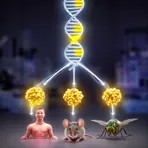
A gene in another species that comes from the same gene in an earlier species and does the same job
 1
6.8
1
6.8
Related because they come from the same origin
Surface Forms
Morphology
Etymology
Homolog comes from the part homo- meaning 'same', a root you also see in homogeneous. In biology a homolog is a gene, organ, or structure in different species with a 'common origin', so the word shows they are 'the same' because of shared ancestry.