
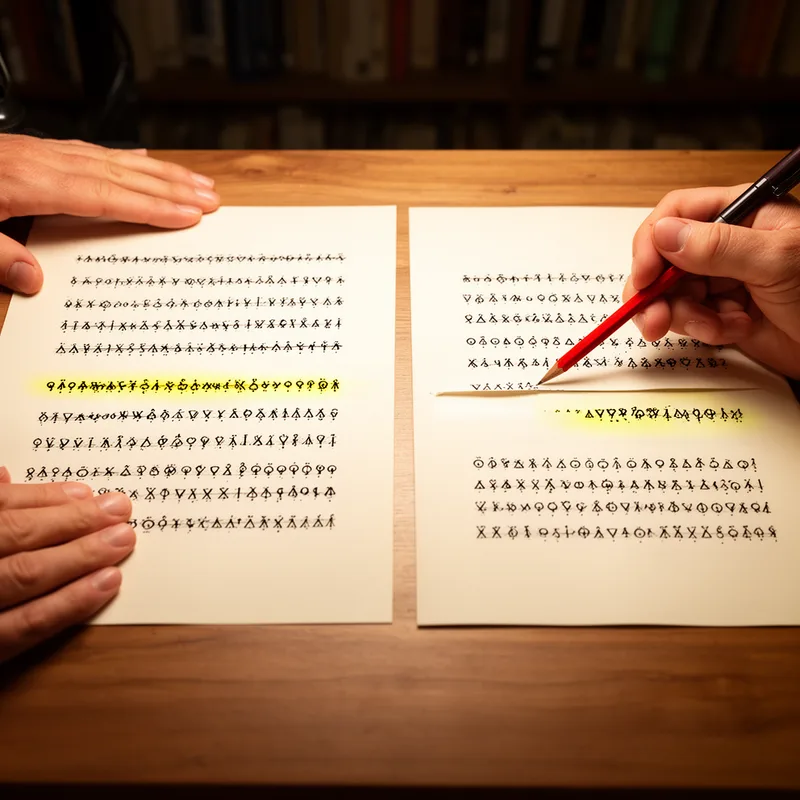
homoeoteleuton
- noun
- /ˌhoʊmiːoʊˈtɛlɪtən/
- UK
- A common example of homoeoteleuton is when a scribe accidentally skips a line of text because the previous and next lines end in the same sequence of letters.
Examples
-
For instance, homoeoteleuton is attributed by textual critics to parablepsis, a supposed sideways eye movement in reading.
Academic text (2001) -
This is a nice example, since it may enable us to explain phenomena like dittography, haplography, homoeoteleuton, and homoearcton by reference to a single type of cognitive/motor mechanism instead of in the somewhat piecemeal way provided in textual criticism.
Academic text (2001) -
In his analysis of ancient manuscripts, the scholar pointed out a homoeoteleuton that caused crucial information to be lost.
-
Textual errors like homoeoteleuton can lead to significant misunderstandings in the interpretation of historical documents.
Synonyms

To accidentally leave out a repeated letter or word when copying text
Surface Forms
Morphology
homoeoteleuton = homoeo + teleuton
The term is built from Greek combining forms (homoeo- + teleuton) that are not productive standalone English words and the meaning is specialized, so a B1 learner cannot reliably derive the sense from familiar English bases.
Etymology
Homoeoteleuton comes from the Greek parts homoio- 'similar' and -teleuton 'ending'. It also names a copying mistake that happens when two lines end the same and the person copying the text accidentally skips a section because their eye jumps.

