
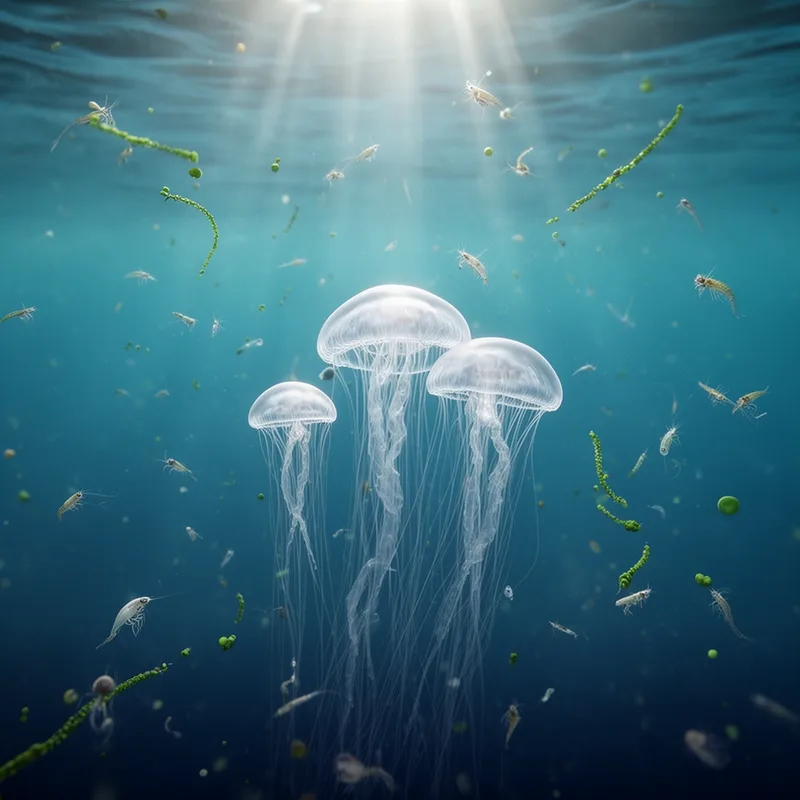
holoplankton
- noun
- /ˌhoʊloʊˈplæŋktən/
- Specialized
- The holoplankton play an essential role in the ocean's food chain, providing nourishment for various marine species.
Examples
-
The meroplankton on continental shelves often dominate the holoplankton (wholly planktonic organisms) during a large part of the year, and different species tend to peak at different times of year, particularly in the spring and autumn, when phytoplankton blooms occur.
Academic text (2000) -
Whether increases in meroplankton are responsible for the decline in holoplankton is impossible to determine without experimental data, but the pattern raises interesting questions about above- and below-SWI linkages.
Academic text (2000) -
Scientists study holoplankton to understand their ecological importance as organisms that live their entire lives in the plankton stage.
-
Due to their small size, holoplankton drift in ocean currents, making them difficult to observe without specialized equipment.
Surface Forms
Morphology
Etymology
The word holoplankton comes from Greek words holo- meaning 'whole' or 'entire' and plankton meaning 'drifters'. So, holoplankton are small animals that drift in the water for their whole life, which is why the word means creatures that never leave the plankton stage.

