
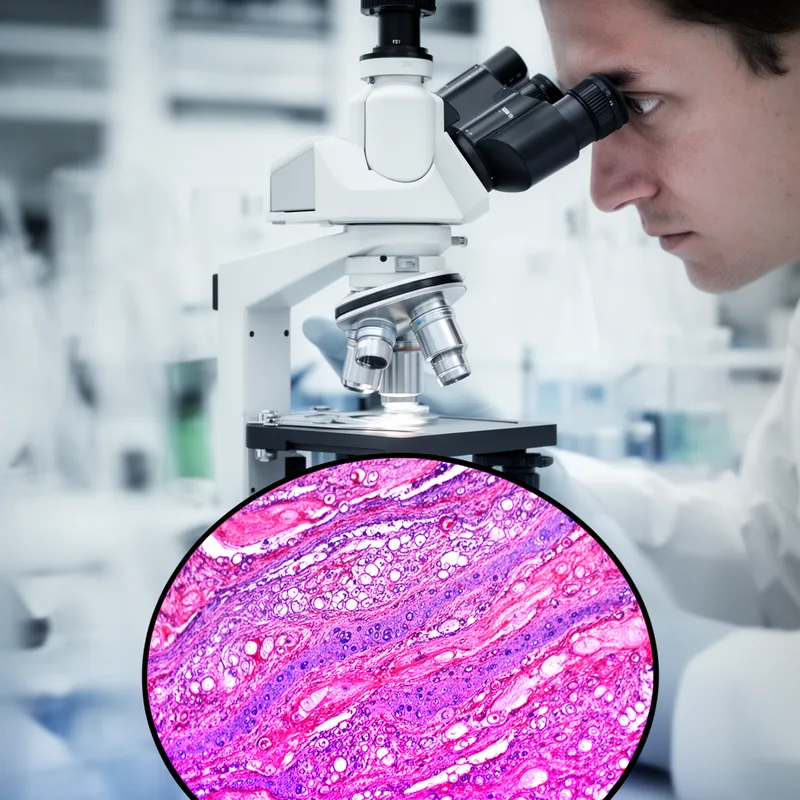
histomorphology
- noun
- /ˌhɪstəʊmɔːrˈfɒlədʒi/
- Specialized
- Examining the histomorphology of the liver tissue under a microscope allowed researchers to identify key structural changes associated with liver disease.
Examples
-
The histomorphology of human foreskin tissue specimens subjected to 50 mmHg static sensor pressure was as follows:
Academic text (2001) -
Histomorphology of control
Academic text (2001) -
The study of histomorphology helps scientists understand how tissues develop and function under normal and diseased conditions.
-
In their research, the team focused on the histomorphology of cancerous tissues to determine their growth patterns.
Synonyms

 3
8.8
3
8.8

The study of the very small parts of plants and animals called tissues, often with a microscope
Study of the tiny parts inside tissues and organs using a microscope
How Microscopic
- Specialized

- Specialized
1
8.1
- Specialized
- Specialized
96
3.8
Surface Forms
Morphology
histomorphology = morphology (semi-transparent) = histo + morphology
The structure is a straightforward addition of the combining form 'histo-' (tissue) to 'morphology', but 'histo-' is a technical combining form that may be unfamiliar to average B1 learners.
Etymology
Histomorphology comes from the parts histo- meaning 'tissue', morpho- meaning 'shape', and -logy meaning 'study'. So, it is the 'study of tissue shape', which explains why the word is used for how tissues look and are formed under a microscope.