
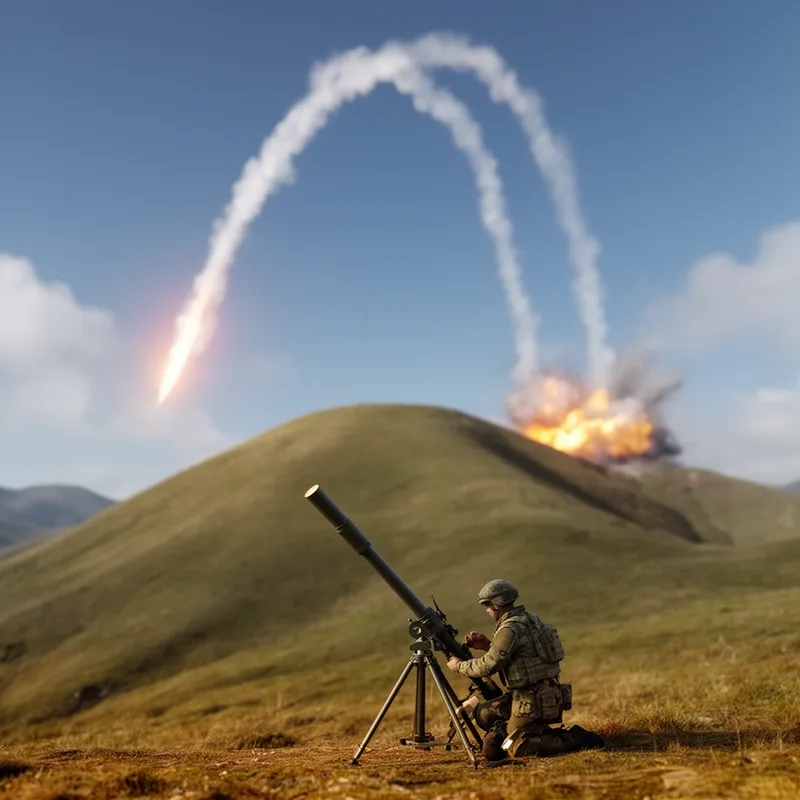
high-angle fire
- noun
- Specialized
- The artillery unit used high-angle fire to target enemy troops on the reverse slope of the hill.
Examples
-
In mountainous terrain, high-angle fire is often necessary to reach hidden positions.
-
The military used high-angle fire to target enemy positions.
-
Mortars are particularly effective for high-angle fire due to their steep trajectories.
-
Can you explain what high-angle fire is?
-
The military used high-angle fire to target enemy positions on the hillside.
-
During the training exercise, soldiers practiced high-angle fire with the mortars.
-
To hit the distant fortifications, the artillery team was ordered to use high-angle fire.
Synonyms

 7
7.9
7
7.9

Soldiers fire explosive shells in a high arc at a target from the ground
How High
- Specialized

- Specialized
- Specialized
7
6.9
- Specialized
1
7.7
Surface Forms
Morphology
high-angle + fire
The phrase is compositionally transparent: 'fire' refers to artillery firing and 'high-angle' signals firing at a high/steep elevation, so the combined meaning (artillery shot with a high, arching trajectory) is directly derivable from the parts. Although somewhat technical, there is no idiomatic shift and the modifier + noun pattern is cross-linguistically common, so a B1 learner who knows the constituent words should understand it.
Etymology
High-angle fire literally names a type of shooting where the parts high and angle tell the story: guns or mortars are fired at a very steep angle so the shell makes a tall arc and drops down behind hills or into trenches. That's why the term means 'fire at a steep angle to reach hidden or sheltered targets'.