

heterocercal
- adjective
- /ˌhɛtərəˈsɜrkəl/
- Specialized
- Sharks are known for their heterocercal tails, where the upper lobe is larger than the lower one.
Examples
-
The prehistoric fish had a distinctly heterocercal tail, unlike most modern species.
-
Sharks are known for their heterocercal caudal fins, which aid in powerful swimming.
-
Paleontologists studied the structure of the heterocercal tail to understand the fish's movement.
-
The shark has a heterocercal tail that helps it swim faster.
-
Many species of fish, such as the sturgeon, feature a heterocercal tail.
-
The heterocercal tail of the ancient fish helped scientists understand its swimming mechanics.
-
Many species of fish, including some sharks, have a heterocercal tail that aids in propulsion.
Synonyms
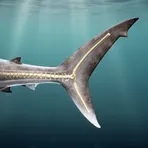
A tail fin with a larger top than bottom and the backbone entering the top, like sharks
Antonyms

- Specialized
With a tail whose upper and lower lobes are the same and extend past the backbone, like most bony fish
Compounds
- Specialized
A tail fin with a larger top than bottom and the backbone entering the top, like sharks
How Symmetrical
- Specialized

- Specialized
Surface Forms
Morphology
heterocercal = cercal (semi-transparent) = hetero + cerc + al
Formally analyzable as hetero- + cercal, but both elements are technical Greek-derived combining forms and the precise anatomical meaning is specialized.
Etymology
The word heterocercal comes from Greek parts hetero- ('different') and cercal (from an old Greek word for 'tail'), and you can see hetero- in words like heterogeneous or heterosexual. So it literally means a 'different tail' and describes a fish tail where the upper part is bigger than the lower and the spine goes into the upper part.

