

herpesvirus
 1
4.9
1
4.9

- noun
- /ˈhɜrpiˌsvaɪrəs/
- Specialized
- The human counterparts exhibit a 63% amino acid sequence homology with mouse IL-17 and 72% amino acid identity with a T-lymphocytic herpesvirus, Herpesvirus saimiri 89.
- human herpesvirus
- herpesvirus infection
Examples
-
As a freelance news writer for The Horse, I'm subject to the same kind of "overdiagnosis syndrome" as anyone in the health industry; your horse coughs and you fear herpesvirus; he shivers and you think tetanus.
Blog text (20) -
We used consensus primers to detect herpesviruses by PCR, but this method is probably less sensitive than one that uses specific primers for each herpesvirus.
Academic text (2015) -
Most animals, including humans, are vulnerable to some form of herpesvirus.
Academic text (1994) -
There is such a thing, believe it or not, as Falconid Herpesvirus.
Blog text (10) -
Of these, feline herpesvirus and FIV are prevalent and very likely endemic in the lions.
Academic text (2009) -
The etiology of Rosai-Dorfman disease is uncertain, although some reports have associated the disorder with Epstein-Barr virus and human herpesvirus 6.
Academic text (1998) -
The malignancy chosen for cloning studies (King and McKinnell 1960) was the herpesvirus-induced (Tweedell 1967, Davison et al. 1999).
Academic text (1999) -
The human counterparts exhibit a 63% amino acid sequence homology with mouse IL-17 and 72% amino acid identity with a T-lymphocytic herpesvirus, Herpesvirus saimiri 89.
Blog text (17) -
Herpes simplex is a common type of herpesvirus that causes cold sores around the mouth.
-
Many people are infected by the chickenpox herpesvirus during childhood, leading to immunity in adulthood.
Synonyms
 1
3.9
1
3.9
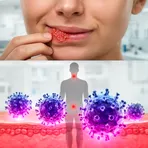
A germ that causes painful sores on the skin, often around the mouth or genitals
Surface Forms
Morphology
Etymology
Herpesvirus comes from the Greek root herpein, meaning 'to creep', and the Latin word virus, meaning 'poison'. A helpful way to remember it is to think of these viruses as ones that 'creep' along the body or hide quietly and then come back, so the name links a creeping action with a cause of disease.