
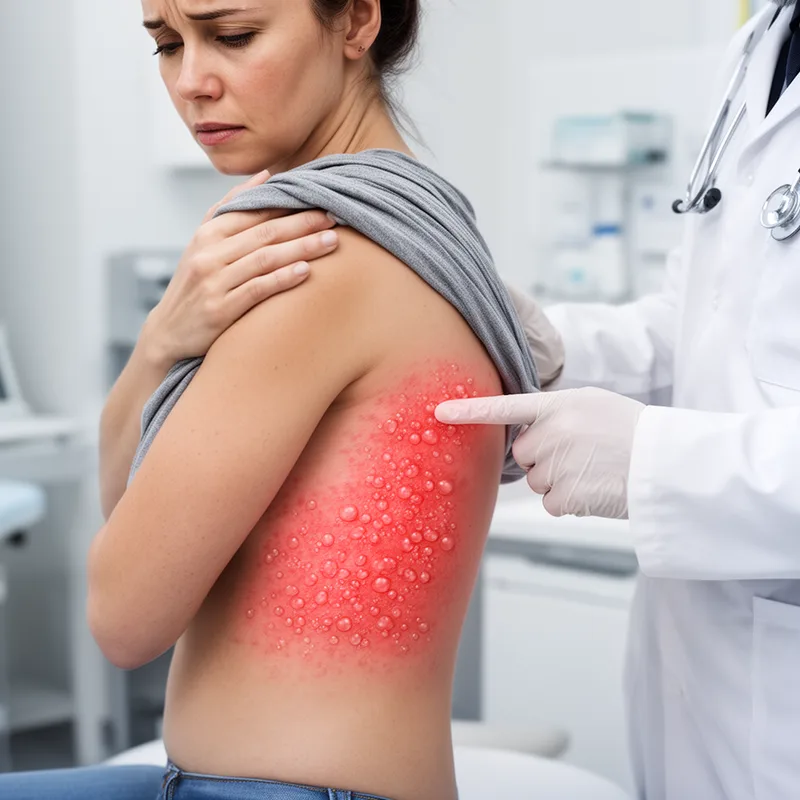
herpes zoster
- noun
- /ˈhɜrpiːz ˈzɔstər/
- Specialized
- Shingles, or herpes zoster, leads to painful skin eruptions along a nerve path.
- shingles, or herpes zoster
Examples
-
Unfortunately, there is nothing that perfectly prevents PHN, but vaccination has been shown to reduce the incidence of herpes zoster by 51.3% in a study of 38,000 adults aged 60 and older who received the vaccine.
Academic text (2012) -
After the initial exposure, herpes zoster lies dormant in certain nerve fibers.
Academic text (2005) -
Herpes zoster, commonly known as shingles, is caused by the same virus responsible for chickenpox.
Academic text (2005) -
Use: treatment of acute herpes zoster and recurrent attacks of genital herpes.
Academic text (2005) -
Individuals who had chickenpox may later experience herpes zoster due to the dormant virus reactivating.
-
Doctors often inform patients that herpes zoster can result in severe neuralgia after the rash appears.
Synonyms

 1
7.8
1
7.8

A painful skin rash in a band that happens when the chickenpox virus becomes active again

A painful skin illness that makes a line of blisters when the chickenpox virus wakes up again

A painful skin rash with blisters caused by the same virus as chickenpox
Surface Forms
Morphology
Both constituents ('herpes' and 'zoster') denote viral infections causing painful skin eruptions, so a learner who knows those words can infer that 'herpes zoster' names a viral condition characterized by painful rash/blisters. This is a compositional, clinical naming pattern rather than an idiomatic or metaphorical phrase, making the meaning derivable from the parts.
Etymology
Herpes zoster comes from two old Greek words: herpes meaning 'to creep' and zoster meaning 'belt'. The name paints a simple picture of a rash that seems to 'creep' along a nerve in a belt-like band, so it refers to the disease we now call 'shingles'.