
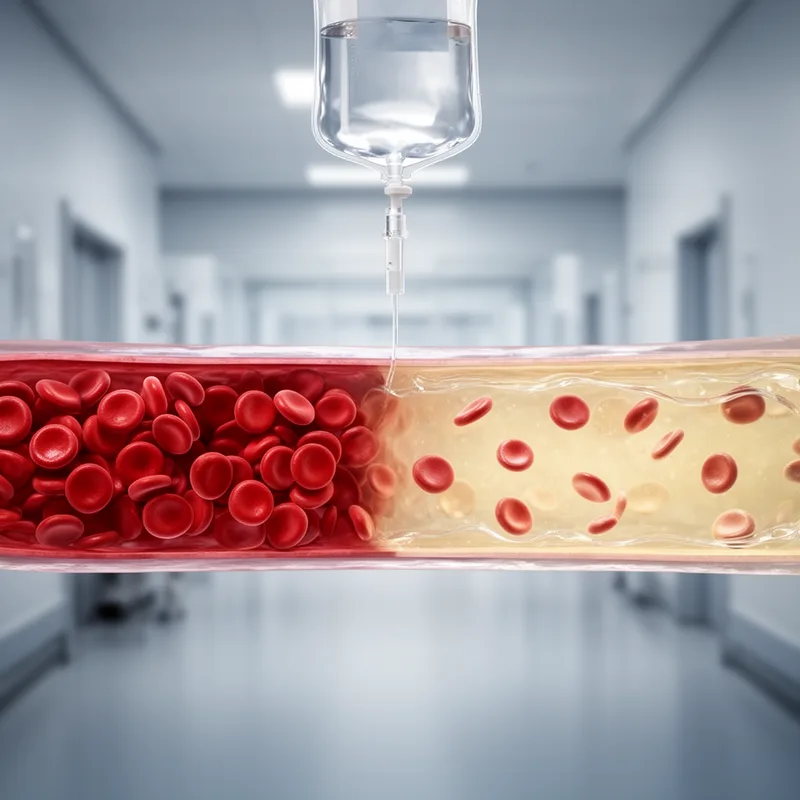
hemodilution
- noun
- /ˌhiːmoʊdɪˈluːʃən/
- Specialized
- During the surgical procedure, the doctors utilized hemodilution to reduce the concentration of blood cells and minimize the risk of complications.
- hypervolemic hemodilution
Examples
-
The use of dextran has also been suggested as a means of creating a hypervolemic hemodilution, thus causing a decrease in blood viscosity and an increase in cochlear blood flow.
Academic text (2001) -
Others have stated that nonspecific hemodilution associated with the stress of surgery is involved.
Academic text (1996) -
Some authors have employed normovolemic hemodilution to produce a decrease in hematocrit without reducing volemia.
Academic text (2001) -
The patient underwent hemodilution to help manage blood viscosity levels before the operation.
-
In cases of trauma, medical teams often consider hemodilution as a method to safely increase blood volume without increasing red blood cell mass.
Synonyms

An excess of fluid in the blood compared with the number of blood cells
Surface Forms
Morphology
Etymology
Hemodilution begins with hemo- meaning 'blood' and uses dilute meaning 'to make thinner'. So, hemodilution is like 'watering down' the blood with extra fluid, which lowers the number of blood cells or the amount of hemoglobin.

