
hematite
 2
9.1
2
9.1

- noun
- /ˈhɛməˌtaɪt/
- Specialized
- The roughed-out beads were then ground and polished into their final form, using hematite as an abrasive.
- red hematite
Examples
-
There are traces of ferric oxide, hematite, in the wound.
-
The rock art was painted with red hematite, yellow ochre, and white mineral pigments that bonded to the rock, making it still visible after a thousand years.
Academic text (2004) -
The singing figure was filled with hematite paint, which is red, the color of life.
Academic text (2010) -
His eyes were the deep gray of hematite; his skin was burnt dark as Cam's.
Fiction book (2001) -
We found traces of iron oxide and hematite.
-
Dust clouds showed smoky hematite gray over brilliant background stars, each sparkling at the correct color and intensity.
Fiction book (1991) -
The walls on each side were layered with iron-rich hematite sands and darker strata of clumped till.
Fiction book (1993) -
For example, we found an unprecedented 4,257 pieces of carved-incised ceramic vessels, many so well preserved that blood-red hematite pigment still adheres to the exterior.
Academic text (2006) -
Stray hogs snuffled in the gutters, their hides a mottled reddish-brown from the hematite-rich dirt.
Fiction book (2002) -
The rock art was painted with red hematite, yellow ochre, and white mineral pigments that bonded to the rock, making it still visible after a thousand years.
Surface Forms
Morphology
hematite = hemat + ite
Built from the combining form 'hemat-' (blood) + mineral suffix '-ite'; the semantic link to blood-colour (red) is present but the combining form is not a standalone English word and '-ite' is a technical mineral suffix, so an average B1 learner is unlikely to fully derive the meaning.
Etymology
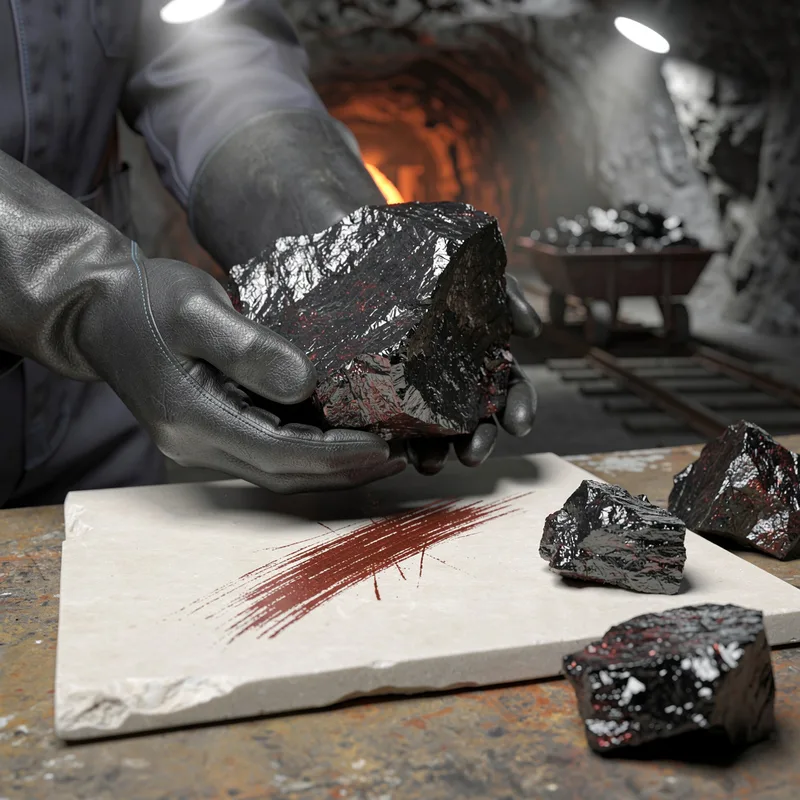
Hematite comes from the Greek root haima, which means 'blood', because the mineral leaves a red streak that looks like blood. You can see the same root in hemoglobin, so hematite is named for its blood-like, iron-rich color.