
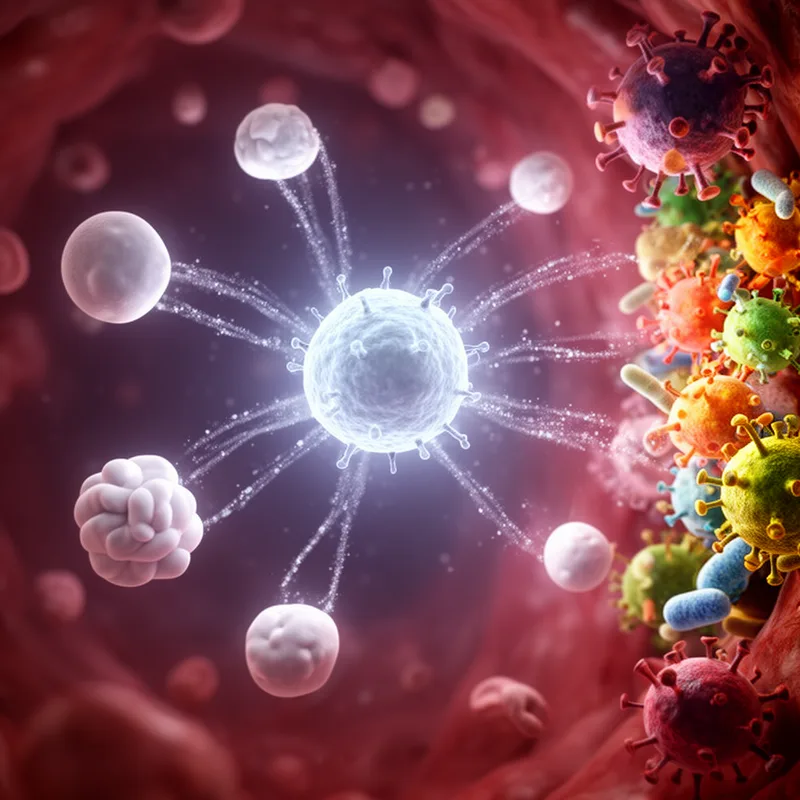
helper cell


 1
4.9
1
4.9
- noun
- /ˈhɛlpər sɛl/
- Specialized
- These two subclasses of T-helper cells differ in their production of cytokines and are reciprocally inhibitory.
- T helper cells
Examples
-
And having said that, now these T helper cells go looking for a congenial B cell.
-
And finally, finally, the macrophage finds AT helper cell over here.
-
One of Darwin's first targets will be the T-helper cell receptor thought to be involved in multiple sclerosis.
Academic text (1993) -
This will be in a in a macrophage which has used its lysosome to become activated, and the T helper cell will recognize that and kill it.
-
One likely explanation is that the main effect of interleukin-12 is in promoting early T-helper cell differentiation at the time of initial antigen presentation.
Academic text (2000) -
T helper cells play a crucial role in activating B cells and killer T cells to fight infections.
-
A decrease in T helper cells can make the body more susceptible to diseases.
-
Research shows that T helper cells are essential for a strong immune response against viruses.
Synonyms
A white blood cell that helps the body fight infection by guiding other immune cells
A white blood cell that recognizes infected cells and helps other immune cells fight infection

A white blood cell that helps control the immune system and that HIV attacks
Surface Forms
Morphology
The compound 'helper' + 'cell' transparently suggests 'a cell that helps', so a B1 learner who knows both words would likely infer a general helping role. However, the precise biomedical sense — a CD4+ T lymphocyte that coordinates immune responses and is targeted by HIV — is specialized and not predictable from the constituents alone, so full understanding requires domain knowledge.
Etymology
Helper cell comes from a simple image: a cell that acts as a helper to other cells. These cells guide and boost other immune cells, so helper cell means a cell that 'helps' or 'supports' the body's fight against infection.