
heliostat


 1
9.3
- noun
- /ˈhiːliəˌstæt/
- Specialized
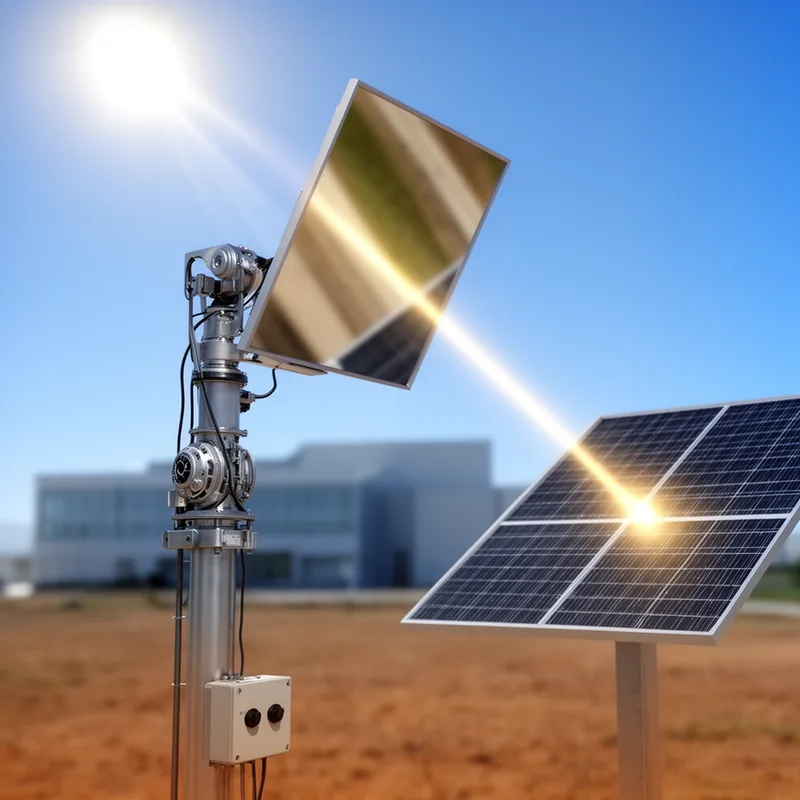
- The heliostat automatically rotates to reflect sunlight towards the solar panels.
- mirrors called heliostats
Examples
-
The heliostat field, the tower, and the turbine-generator will require only minimal modifications.
Academic text (1994) -
In these systems, a field of two-axis tracking mirrors, called heliostats, reflects the solar energy onto a receiver mounted on top of a centrally located tower (Figure 1b).
Academic text (1994) -
Fed by a heliostat, it produced a solar image almost seven inches in diameter.
Academic text (1992) -
PHOTO: Figure 4. Solar One with the heliostat field aimed at the stand-by position.
Academic text (1994) -
You have a whole bunch of heliostats, thousands of them, so slanted mirrors that again reflect this light.
-
Here we utilize the sun's rays from the heliostat.
-
Sunlight can be used as heat or electricity and is converted through optical cells, solar panels, or mirrors called heliostats synchronized with the sun as it moves.
Blog text (4) -
Therefore, the building will be provided with laboratories for optical, spectroscopic, and chemical work, concave grating rooms, large dark rooms, developing, emulsion and enlarging rooms, a galvanometer electronics room, and the large heliostat room.
Academic text (1992) -
In our experiment, the heliostat tracked the sun's movement throughout the day.
-
Engineers designed the heliostat to maintain a steady reflection of sunlight for energy collection.
Surface Forms
Morphology
heliostat = helio + stat
Formed from Greek combining elements helio- ('sun') and -stat ('standing/device'), which are not productive standalone words for average B1 learners, so the meaning is not directly derivable from familiar English bases.
Etymology
Heliostat comes from the Greek helios ('sun') and -stat ('to stand' or 'stay in place'), like in thermostat. So a heliostat is a device that 'stands' the sun in one direction by moving a mirror to keep sunlight steady where you want it.