
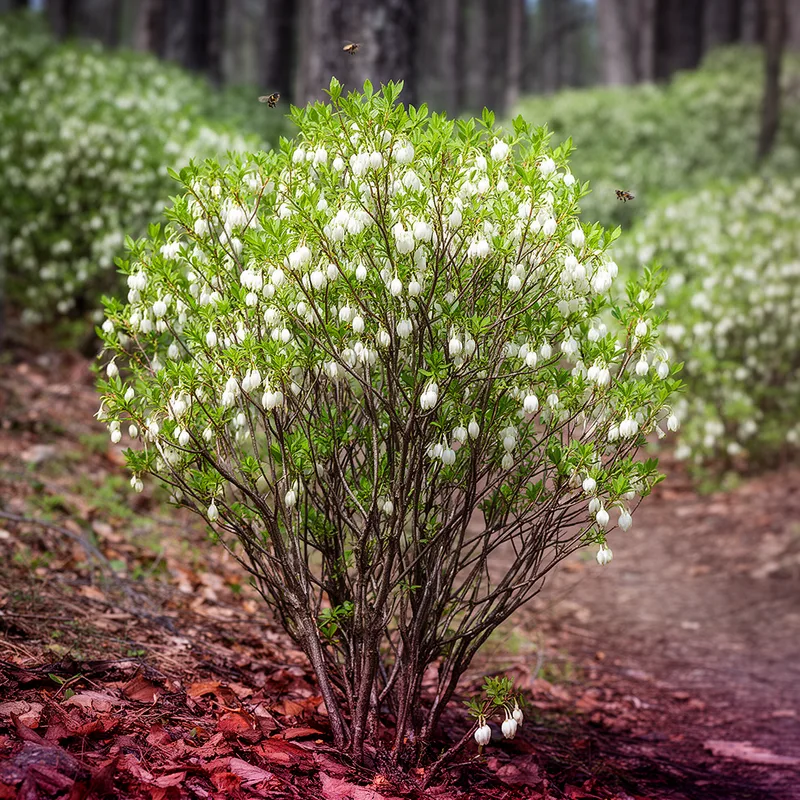
he-huckleberry
- noun
- Specialized
- The he-huckleberry attracts bees and other pollinators with its bell-shaped flowers.
Examples
-
The forest path was lined with he-huckleberry shrubs in full bloom.
-
Botanists identified several varieties of he-huckleberry growing along the hillside.
-
The he-huckleberry blooms beautifully in the spring.
-
Many he-huckleberries can be found in the forest.
-
The he-huckleberry produces clusters of small white flowers that attract various insects.
-
In spring, the he-huckleberry fills the garden with its fragrant, bell-shaped blossoms.
-
You can see the he-huckleberry shrubs thriving near the water's edge during the blooming season.
Synonyms
A bush that loses its leaves and has clusters of small white bell-shaped flowers
A bush with many branches that loses its leaves and has small white flowers in clusters
A bush with many branches and groups of small white bell-shaped flowers

A shrub that loses its leaves and has dense clusters of small white bell-shaped flowers
Surface Forms
Morphology
he-huckleberry = he + huckleberry (semi-transparent) = he + huckleberry
The components 'he' + 'huckleberry' are visible, but the role of 'he-' as a modifier in a plant name is not a productive, fully predictable morphological operation for learners.
Etymology
The word he-huckleberry comes from the familiar huckleberry ('a small berry plant') with an added he- that is probably a local or old way to name a particular bush, so a helpful way to remember it is to think of a specific huckleberry shrub. So, the name tells you it is a kind of huckleberry shrub with many branches and bell-shaped flowers.

