
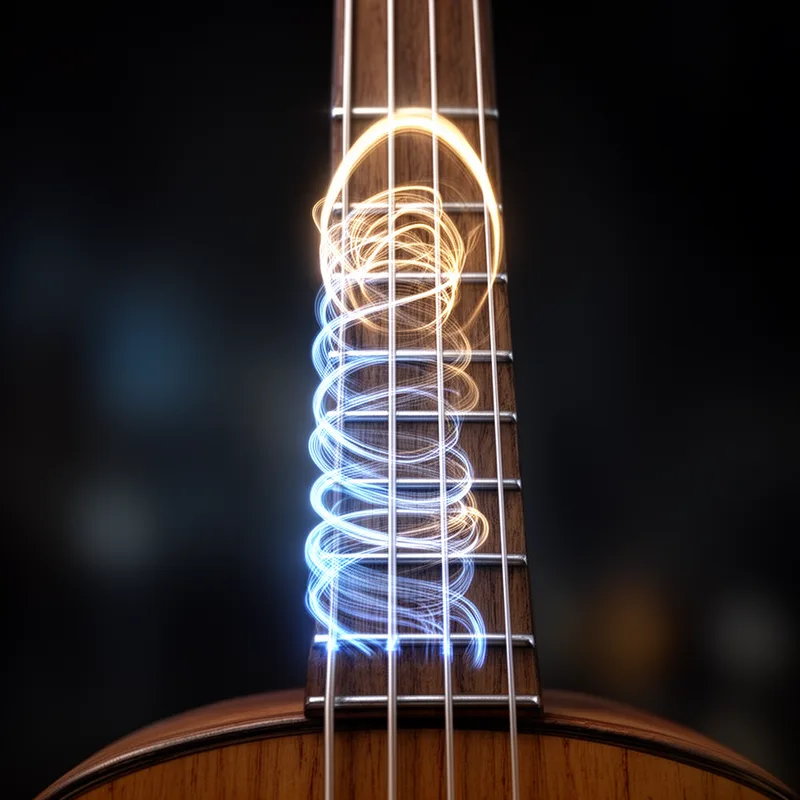
harmonics
 12
7.7
12
7.7

- noun
- /hɑːrˈmɒnɪks/
- Specialized
 :
armónicos
:
armónicos
- Each instrument produces unique harmonics that contribute to its distinct tone.
- odd harmonics
- even harmonics
- first harmonics
Maybe I can play that game and get rid of more harmonics by switching more?
- Maybe I can play that game and get rid of more harmonics by switching more?
- And when I hear him play, I just start thinking of these players like Eddie Van Halen, the harmonics that he was doing the other night and and the the sounds like this.
Examples
-
The vibrations of the harmonics are all integer multiples of the fundamental frequency.
Academic text (2004) -
Now, this semester, we are going to be diving into the power of harmonics.
-
So these are the third harmonics up here.
-
And of course, these are simply the different, different harmonics of the string.
-
I understand you use harmonics of atomic frequencies.
-
Voice is characterized by its intensity, frequency, and harmonics.
Academic text (2015) -
Following Fourier's formulation, the harmonics, which are generally called frequency components, are each represented by complex exponential functions.
Academic text (2011) -
Instruments such as the gong and metallophone have a broader frequency field (including many harmonics).
Academic text (2009) -
Bobby McGregor worked along the twelfth fret of the Martin, using harmonics to fine-tune it.
Fiction book (1993) -
The vibrations of the harmonics create a rich and complex sound in music.
Surface Forms
Morphology
Etymology
Harmonics comes from the Greek root harmonia, meaning 'fitting together', and it is the same root as the common word harmony. So harmonics are the higher tones or sounds that 'fit together' with a main note to make the musical sound we hear.