
haptoglobin
 1
9.9

- noun
- /ˌhæp.təˈɡloʊ.bɪn/
- Specialized
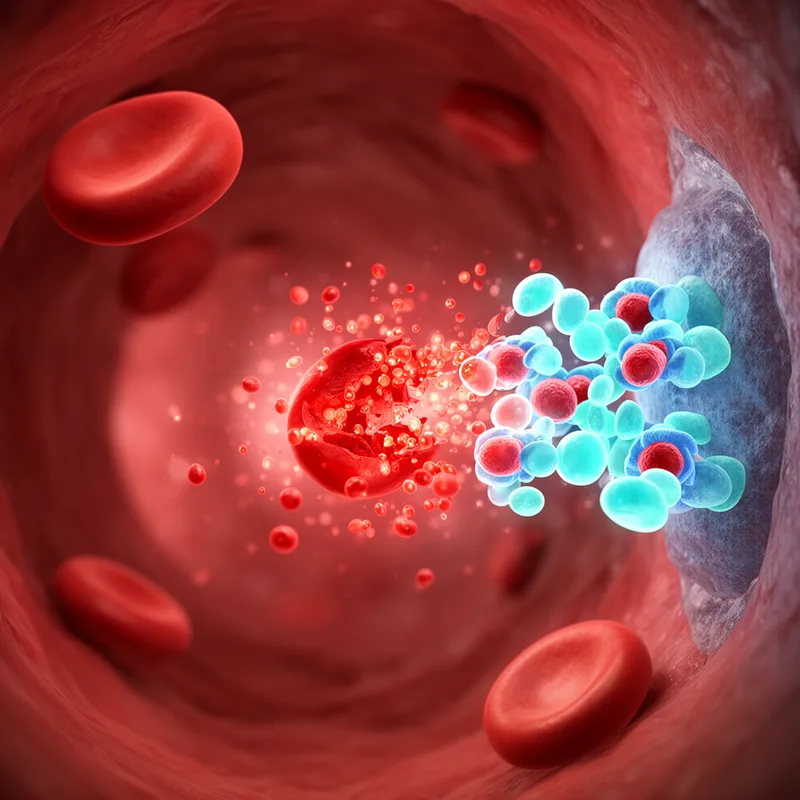
- When free hemoglobin is present, haptoglobin helps clear it from circulation.
- serum haptoglobin
- haptoglobin and fibrinogen
Examples
-
When hemoglobin levels exceed the binding capacity of haptoglobin, the serum will become red or brownish, and hemoglobin will also be released into the urine.
Blog text (9) -
Humans are the only species with a modified form of haptoglobin, programmed by a gene acquired after human predecessors, Australopithecus, diverged from "Pan" apes.
Blog text (12) -
Hemoglobin is normally retained in the serum by binding to a specific protein called haptoglobin.
Blog text (9) -
Ordinarily, haptoglobin is responsible for "cleaning up" free hemoglobin in the bloodstream.
Blog text (12) -
The functions of this protein are distinct from haptoglobin's role in hemoglobin scavenging.
Blog text (12) -
Hemoglobin is contained within red blood cells, but when damaged, free hemoglobin is released, which is toxic; haptoglobin then "cleans" up the hemoglobin for disposal.
Blog text (12) -
Among the issues he highlighted was the fact that Homo sapiens have a gene that no other species possesses, a gene for a modified form of the protein haptoglobin.
Blog text (12) -
Moreover, significant differences have been encountered in acute phase response, and results showed a significant decrease in haptoglobin and fibrinogen in diseased newborn foals compared to controls.
Academic text (2014) -
LDH was 1249 IU/L, serum haptoglobin was less than 8 (normal 43-212 units), and ANA titer was positive at 1:80.
Academic text (2007) -
The haptoglobin protein binds free hemoglobin, aiding its removal from the bloodstream.
Surface Forms
Morphology
Etymology
Haptoglobin comes from Greek parts hapto- meaning 'to bind' and -globin as in hemoglobin meaning 'blood protein'. So haptoglobin is a protein that binds free hemoglobin in the blood, which is exactly its job.