
halophyte
- noun
- /ˈhæləˌfaɪt/
- Specialized
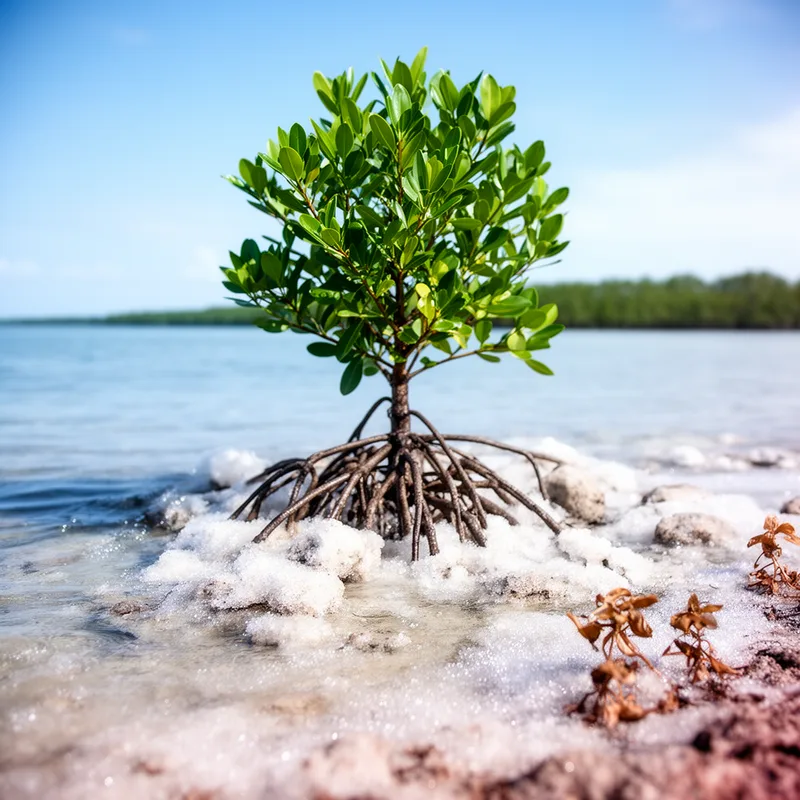
- Halophytes are unique plants that thrive in environments with high salt concentrations, such as coastal marshes.
- marsh halophytes
- plain halophytes
- other halophytes
Examples
-
We focus on the broad marsh plain, which is dominated by eight species of halophytes (salt-tolerant plants).
Academic text (2001) -
Many halophytes compensate for evaporation by depositing salt crystals on the surfaces of their leaves, giving the leaves a grayish silver cast.
Academic text (2003) -
Spatial and temporal patterns of halophyte diversity on the marsh plain.
Academic text (2001) -
The marsh plain halophytes, although not very showy (Table 1), are still at risk.
Academic text (2001) -
Life history and growth forms of eight halophytes common to the marsh plain of Californian coastal wetlands.
Academic text (2001) -
Most other halophytes also show an important recovery of germination when stress conditions are alleviated (Qu et al., 2007).
Academic text (2014) -
Thus, for halophytes, seed must remain viable under high salinity conditions and germinate until salinity decreases (Qu et al., 2008).
Academic text (2014) -
Most halophytes have high salt tolerance in seed germination, whereas the seedling stage is always the most fragile (Kitajima and Fenner, 2000).
Academic text (2014) -
Historical records of eight halophyte distributions in 23 coastal salt marshes (Table 2) show that only three species are very widespread (Sv, Fs, Jc; species codes are in Table 1).
Academic text (2001) -
In regions where the soil is highly saline, halophytes like saltwort and sea lavender can often be found.
How Salt-Tolerant
- Specialized

Surface Forms
Morphology
halophyte = halo + phyte
The word is built from Greek combining forms halo- ('salt') and -phyte ('plant') used in specialized scientific vocabulary, which are not recognizable to an average B1 learner from everyday English words.
Etymology
Halophyte comes from the Greek parts halo- 'salt' and -phyte 'plant', so it means 'salt plant'. That's why halophytes are plants that naturally grow in very salty soil or places.

