
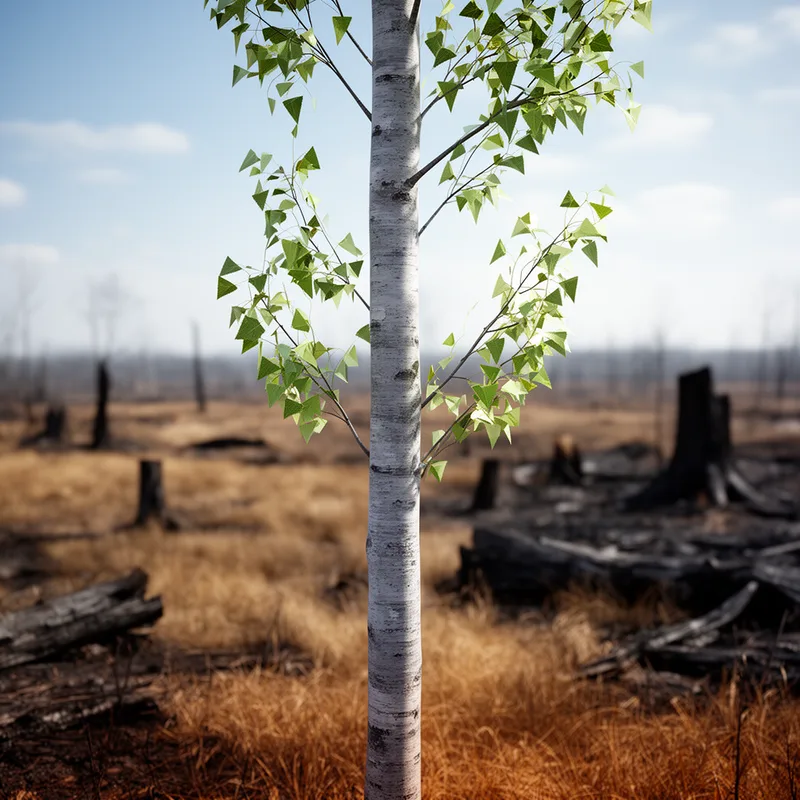
gray birch
- noun
- /ɡreɪ bɜrʧ/
- US
- The gray birch is commonly found in the forests of North America, characterized by its light-colored bark.
Examples
-
Bear oak and pitch pine are the dominant trees, usually associated with bigtooth aspen, gray birch, mountain laurel, mountain maple, paper birch, and sassafras.
Academic text (2011) -
During our hike, we spotted several gray birches dotting the landscape with their distinctive pale bark.
-
The natural area was filled with gray birches, which thrive in disturbed environments after logging.
Synonyms

A medium-sized birch tree with white or pale grey bark

A medium-sized birch tree with white or pale grey bark from eastern North America
Surface Forms
Morphology
The meaning is directly compositional: 'gray' describes the color and 'birch' names the tree, so a learner who knows both words can infer it refers to a birch tree that is gray in appearance. This adjective+noun naming pattern is common cross-linguistically and follows standard English compound formation, making the phrase immediately understandable to a B1 learner.
Etymology
Gray birch comes from a simple picture: a birch tree with pale, gray bark that often grows in old fields or burned places. So the name helps you remember that it is a small, pale-barked 'birch' that grows in poor, changed ground and has wood of little value.

