

graven image
 3
9.3
3
9.3

- noun
- /ˈɡreɪvən ˈɪmɪdʒ/
- Archaic
- The second commandment, in short form, reads: "Thou shalt not make unto thee any graven image."
- forbids graven images
- worship graven images
- make a graven image
Loading YouTube…
Watch on YouTubeAnd they forbid the making of graven images.
- And they forbid the making of graven images.
- Thou shalt not make any graven image.
Examples
-
Their stance comes from Exodus 20:4 in the Bible, which reads, "You shall not make for yourself a graven image or a likeness of anything."
Academic text (2004) -
And the Second Commandment says, "Don't make yourself a graven image," or a false god.
-
You fill your palace... ...with graven images, and you forget your God.
-
Maybe my daughter ought to be more careful what she wishes for when it comes to these graven images.
-
"My father really does worship graven images.
Fiction book (2000) -
I am the LORD: that is my name; and my glory will I not give to graven images.
Blog text (34) -
Only the priests were aware on a daily basis of the graven images at the heart of the Temple.
Blog text (34) -
Our religion forbids graven images in the Temple.
-
Thou shalt not bow down before any graven image.
-
Our religion forbids graven images in the Temple.
Synonyms
 65
4.1
65
4.1
An image of a god that people worship
 55
3.0
55
3.0
An object or image that people worship and treat as having power
 25
6.7
25
6.7
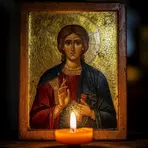
A painted image of a holy person used in Eastern Orthodox worship

A painted image of a holy person used in worship
Surface Forms
Morphology
graven + image
The phrase composes transparently from 'graven' (engraved/carved) and 'image' (a representation), so a learner who knows both words would infer a carved or made representation. However, the specific religious/idiomatic sense — an idol that is worshipped or forbidden (a biblical legal usage) — is a cultural extension not fully predictable from the literal parts (and 'graven' is archaic), so the meaning is only partially derivable.
Etymology
Graven image comes from the old word graven meaning 'carved' and image meaning a picture or statue. People made carved figures and would 'worship' them, so the phrase now means a statue or thing treated like an 'idol' and often 'not allowed' in religious rules.