
grand tour
 1
9.3
1
9.3

- noun
- /ɡrænd tʊr/
- Archaic
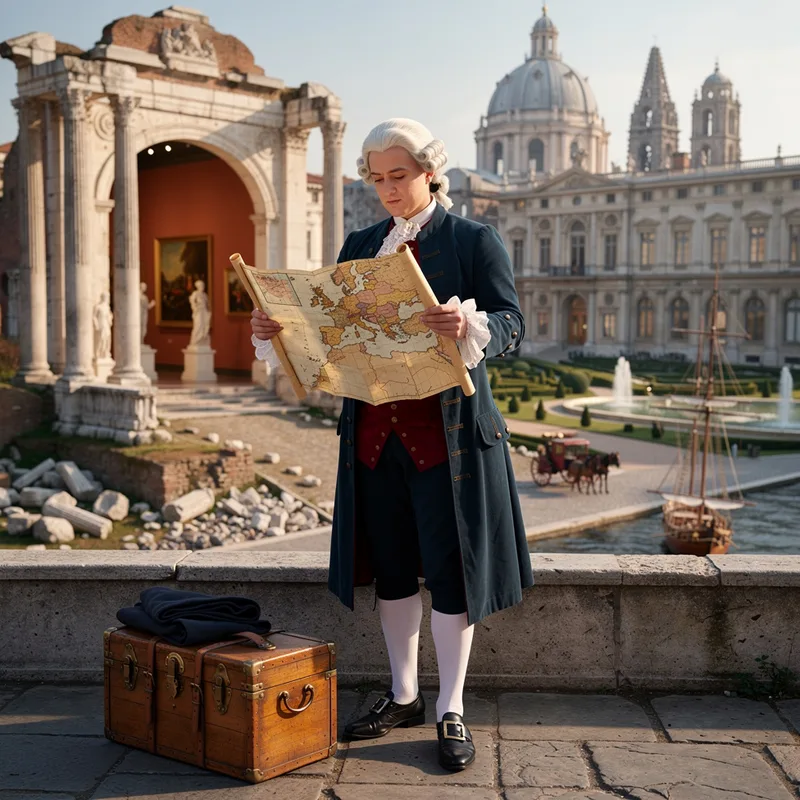
- Many young aristocrats in the 18th century embarked on a grand tour of Europe to enhance their cultural education.
- took a grand tour
- made a grand tour
- grand tour of Europe
Examples
-
In the summer of 1891, Katharine Bradley and Edith Cooper, the pair of British women who wrote under the pseudonym Michael Field, arrived in Paris to begin their grand tour of European art.
Academic text (2017) -
Born in New York City on December 19, 1901, Oliver La Farge entered a world of privilege that included summers on Narragansett Bay, family friendship with the Roosevelts, a private education in New York and Massachusetts, and a grand tour of Europe.
Academic text (1998) -
But after the engagement party, I'm going to take you on a grand tour around town.
-
Well, now, after this little Grand Tour of our own, I'm going to return to Hamilton as a painter.
-
Coincidence, providence, and the gods of the road were on my side, ensuring that as I made a grand tour of Europe, I would find my way into the right place at the right time.
Fiction book (1997) -
His grand tour included visits to iconic cities such as Paris, Rome, and Vienna, providing him with a rich experience of European history.
-
During their grand tour, the students studied art and architecture while exploring famous landmarks across Europe.
Synonyms
 819
1.0
819
1.0
A trip visiting several places and returning to the start, usually for work or pleasure
 33
1.1
33
1.1
Visiting interesting places when you travel
How Long

Surface Forms
Morphology
The words 'grand' (magnificent) + 'tour' (trip) transparently give the sense of an impressive or large journey, so a B1 learner would likely infer a general meaning like 'a splendid trip.' However, the phrase's conventional, historically specific meaning (an extended 18th‑century educational circuit through Europe) is culturally specialized and not predictable from the constituents alone, making the expression only partially transparent.
Etymology
Grand tour started as the name for the long trips rich young English people took through Europe in the 1700s to see art and famous cities. Think of grand meaning 'big' and tour meaning 'trip', so it came to mean 'an extended journey' for learning about culture and art.