

go (game)
- noun
- /ɡoʊ/
- Learning the rules of go can take a few minutes, but mastering the game takes a lifetime.
Examples
-
He spent the evening playing go with his friends at the club.
-
Some say that go is even more complex than chess in terms of strategy.
-
He spent the evening playing go with his friends at the club.
-
Learning the rules of go can take a few minutes, but mastering the game takes a lifetime.
-
Some say that go is even more complex than chess in terms of strategy.
Synonyms
 100
7.6
100
7.6

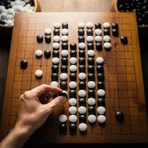
A board game for two players who place black and white stones to surround and capture pieces
Surface Forms
Morphology
Go + (game)
This entry is a lexicalized name for the East Asian board game 'go' and its meaning is not compositionally derived from the constituents 'go' (a common verb) + 'game'. Knowing the words 'go' and 'game' would not allow a B1 learner to infer the specific ancient territory-capture board game (the term is a borrowed proper name and has different equivalents cross-linguistically), so the sense is unpredictable.
Etymology
The board game go comes from East Asia and the English name comes from the Japanese word go, which is short for 'igo'. In the game players place black and white stones on a grid to 'surround' and capture the other player's stones, so the name links to the idea of surrounding and capturing.