
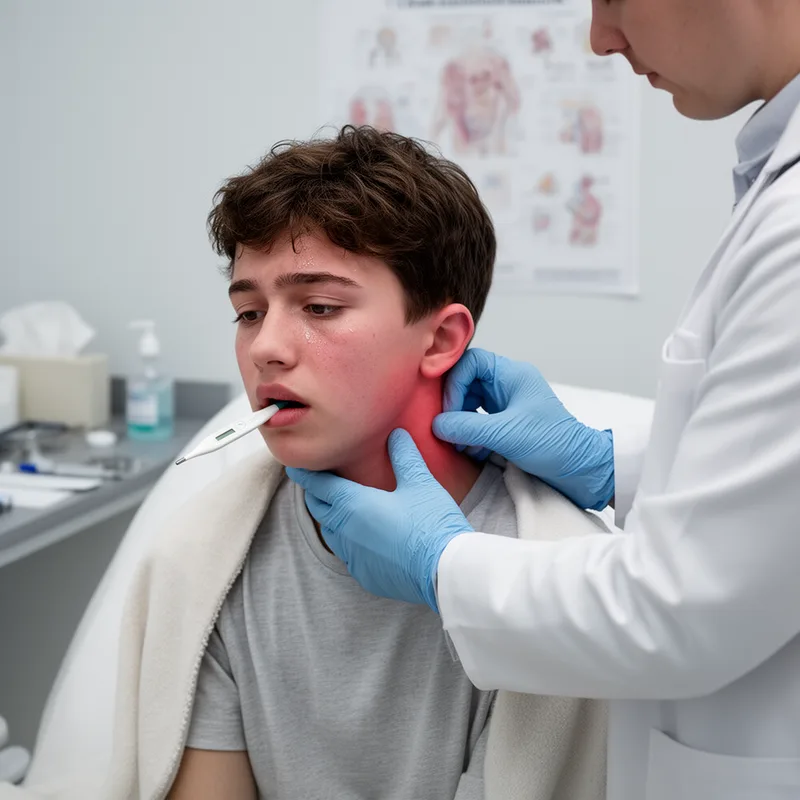
glandular fever
- noun
- /ˈɡlændjələr ˈfiːvər/
- UK
- He was diagnosed with glandular fever last week.
Loading YouTube…
Watch on YouTubeYou know, and I remember one of the very first jobs I had, I was when I, I got glandular fever.
- You know, and I remember one of the very first jobs I had, I was when I, I got glandular fever.
Examples
-
After recovering from glandular fever, she felt an increase in her energy levels and was able to return to work.
-
After two weeks of constant fatigue, the doctor diagnosed her with glandular fever.
-
Because glandular fever is sometimes spread by saliva, it's popularly known as the kissing disease.
-
Many teenagers develop glandular fever at some point, often experiencing swollen glands and a sore throat.
-
Many young adults suffer from glandular fever during college.
-
Many young adults are affected by glandular fever, which causes symptoms like fever and swollen lymph nodes.
-
He was diagnosed with glandular fever after experiencing chronic fatigue and a sore throat for weeks.
Synonyms

 15
7.4
15
7.4

An infection that causes fever, sore throat, tiredness, and swollen glands
 3
6.5
3
6.5
A disease you catch that causes fever, swollen glands, and long tiredness


 1
3.7
1
3.7
An illness caused by a virus that spreads through saliva between people

A sickness caused by a virus that gives fever, sore throat, and swollen glands
Surface Forms
Morphology
The term straightforwardly combines 'glandular' (relating to glands) with 'fever', so its basic meaning — an illness involving the glands that causes fever — is directly derivable from the constituents. While medically it names a specific infection (infectious mononucleosis), that specific etiological detail is not needed for basic comprehension, making it transparent to a learner who knows both words.
Etymology
Glandular fever gets its name from a simple image: glandular refers to the swollen 'glands' in the neck and fever to a high temperature. That's why it means an illness with fever, tiredness, and swollen glands, and it is often called the 'kissing disease' because it can spread by kissing.