

to get on
 37
1.0
37
1.0

- phrasal verb
- /ɡɛt ɑn/
- He carefully gets on the bicycle to ride down the hill.
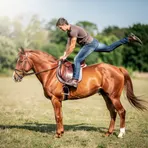
- get on a horse
- get on a bike
- get on someone's back
Loading YouTube…
Watch on YouTubeAnd one of the brothers had got on top of Caesar.
- And one of the brothers had got on top of Caesar.
- And at one point the this woman gets on stage and she's afraid of heights.
- She, she gets on the stand and testifies for me.
- Like he's too tall so get on the end of the bed and he can stand up.
- I'm like, how, how can I get on this jet ski?
- It's like before I got on my, like, hover bike, I went.
- And then what you going to do when pets get on it?
Examples
-
The only thing left was to actually get on my bike and ride it to work.
Blog text (23) -
And then I would get on one and ride it around.
-
I wanted to get on a bus and find her.
Fiction book (2001) -
We could sit here and chat, or you could get on the horse.
-
And now I'm about to get on the jet Ski with Ruby.
-
Narrator 2: Atreyu gets on a horse and sets out for the Childlike Empress's tower.
Fiction book (2001) -
She decided to get on the horse for her first riding lesson.
-
As soon as he gets on the jet ski, he zooms across the water.
Synonyms
 53
2.7
53
2.7
To get onto something like a horse, bike, or bus quickly and lightly
 49
3.0
49
3.0
To get on an animal or bike to ride
 19
2.0
19
2.0
To get up onto the back or top of something, especially an animal
 13
1.8
13
1.8
To get quickly onto the back of something like a horse or bike
 7
4.0
7
4.0
To get onto the back of an animal like a horse to ride it
 1
8.8
1
8.8
To sit or stand with a leg on each side of something like a horse
Antonyms


How High

Surface Forms
Morphology
The meaning 'to board' is directly compositional from 'get' (to move/arrive/enter) plus the locative/onto sense of 'on', so a learner who knows both words can infer entering or boarding a vehicle. This verb+particle pattern is frequent in English and has clear parallels in other languages, making it readily understandable at B1.
Etymology
Get on (to climb or mount onto something) is very literal: you get on a horse, bike, or ladder by stepping up and putting yourself on it. That's why it means 'to climb onto' or 'mount'.