
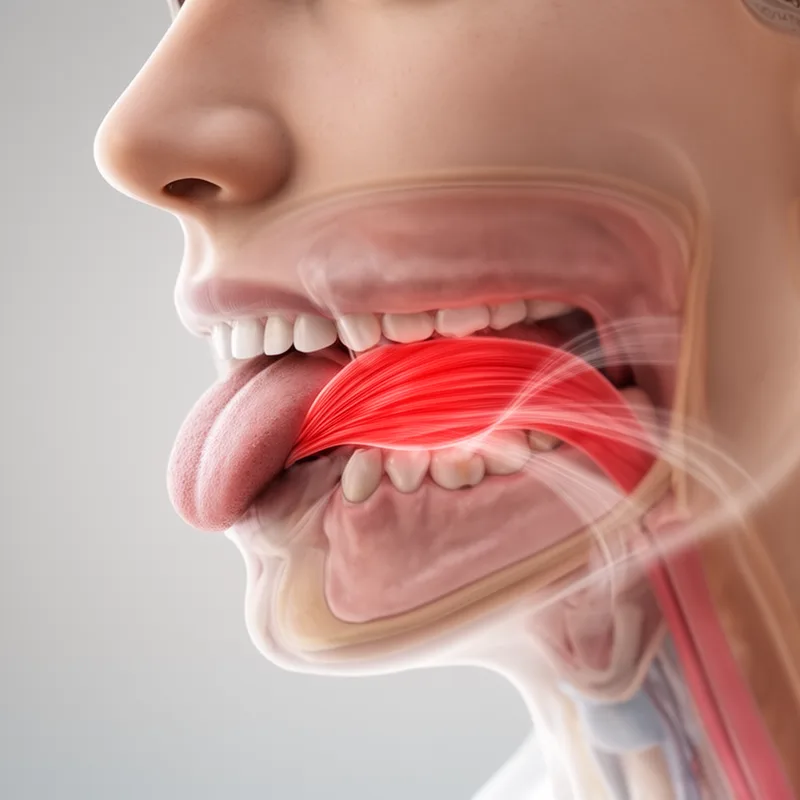
genioglossus
- noun
- /ˌdʒiːniˈɡlɒsəs/
- Specialized
- The genioglossus muscle helps move the tongue forward for clearer speech.
- genioglossus advancement
- osteotomy with genioglossus
- mandibular osteotomy with genioglossus
Examples
-
Anterior repositioning of the genioglossus muscle is achieved by a conservative mandibular osteotomy that advances the genial tubercle without moving the teeth or mandible.
Academic text (1999) -
It improves the tension of the genioglossus muscle and decreases its collapsibility during sleep, thus alleviating obstruction.
Academic text (1999) -
A previous genioglossus advancement is shown.
Academic text (1999) -
Mandibular osteotomy with genioglossus advancement.
Academic text (1999) -
We have also found that in some patients, the hypopharyngeal airway obstruction can be treated with genioglossus advancement only, so a hyoid procedure is not always necessary.
Academic text (1999) -
The current technique of mandibular osteotomy with genioglossus advancement involves a limited osteotomy intraorally to isolate and advance the genial tubercle.
Academic text (1999) -
During the surgery, the doctor adjusted the genioglossus to improve the patient's swallowing ability.
-
Understanding the role of the genioglossus is crucial for treating certain sleep disorders.
Surface Forms
Morphology
genioglossus = genio + glossus
The components 'genio' and 'glossus' are derived from Greek roots and are not transparent to the average English learner.
Etymology
Genioglossus comes from parts meaning 'chin' (genio-) and 'tongue' (-glossus). Think of glossary, which uses the same 'gloss' root for 'tongue' or language. That's why the genioglossus is the muscle that pushes the tongue forward and helps speech and swallowing.

