

garrison
 41
6.8
41
6.8

- noun
- /ˈɡɛrɪsən/
- Though sporadic resistance continues, by Sunday, all the main rebel garrisons have surrendered.
- military garrison
- garrison duty
- soldiers and garrisons
Loading YouTube…
Watch on YouTubeAnd then after that, they took him to in front of the Garrison of the Roman soldiers.
- And then after that, they took him to in front of the Garrison of the Roman soldiers.
Examples
-
The Alexandrian Garrison surrendered at once, which at last brought the siege of Alexandria to an end.
-
Soldiers from the local garrison were in formation to the east of the square.
Academic text (1991) -
An entire garrison, and no one saw anything?
-
" The captain of the garrison wants to question all of you."
Fiction book (1995) -
Intelligence suggests a garrison of 50 to 60.
-
We need to attack all the army garrisons in the area.
-
Sentries open the wooden doors to the garrison, standing on either side of the gate.
Fiction book (1998) -
First, the Frederica settlers wanted the garrison for their protection.
Academic text (2011) -
The major issue of French diplomacy in 1862 concerned the garrison of French troops in Rome.
Academic text (1997) -
The general inspected the soldiers stationed at the garrison before the mission began.
Synonyms
 ∞
2.0
∞
2.0
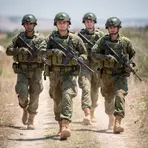
Soldiers who work together as a group in an army
 ∞
3.0
∞
3.0
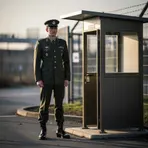
A place where someone is sent to do duty, for example in the military
 ∞
2.2
∞
2.2
A place where soldiers or an organization live and work
 560
3.1
560
3.1
A job or position in an organization where someone works
 156
3.2
156
3.2
A group of soldiers organized to protect or fight for a country
 98
3.2
98
3.2
A group of soldiers organized to fight or carry out military tasks
 19
3.7
19
3.7
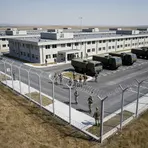
A base or group of buildings where soldiers live and work
 9
2.6
9
2.6
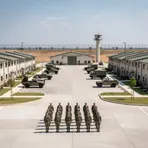
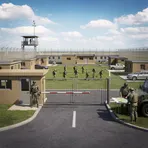
A place where soldiers live, train, and work
 4
4.2
4
4.2
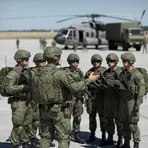
A place where soldiers live and work to defend an area
 2
3.1
2
3.1
A unit of soldiers organized to do a specific job for the armed forces
Compounds

How Large

Surface Forms
Etymology
Garrison comes from Old French garnison, based on the verb garnir which meant 'to equip' or 'to defend', and is like the English word garnish. So a garrison is a place or group 'equipped' with soldiers to defend a fort, which explains its modern meaning.