
ganglion cell


 1
5.5
1
5.5
- noun
- /ˈɡæŋɡliən sɛl/
- Specialized
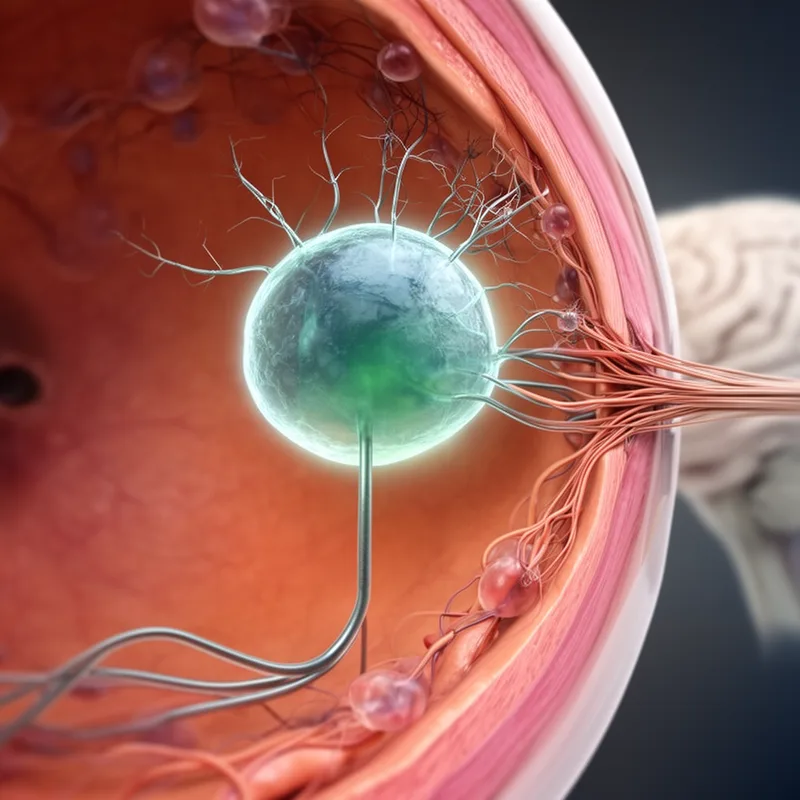
- The retina contains approximately 1 million ganglion cells that transmit visual information to the brain.
- types of ganglion cells
Loading YouTube…
Watch on YouTubeThis is a subconscious mechanism by which these neurons, which are called melanopsin ganglion cells.
- This is a subconscious mechanism by which these neurons, which are called melanopsin ganglion cells.
Examples
-
In patients with glaucoma, the loss of ganglion cells can lead to vision impairment over time.
-
OK, before we get to the ganglion cells, the next cell type is endocrine cells.
-
Foci of less mature ganglion cells were also identified.
Academic text (2010) -
Another distinction can be seen in the ganglion cells projecting from the retina.
Academic text (1997) -
The gradual polarization change is propagated to a bipolar cell and then to a ganglion cell.
Blog text (2) -
High-power neurofilament stain (B) shows normal axon and ganglion cell reactivity.
Academic text (2010) -
Along the axons were multiple foci of mature ganglion cells with well-formed Nissl bodies in the peripheral cytoplasm.
Academic text (2010) -
Low-power view (A) reveals ganglion cells and axons surrounded by fibrous stroma and adipocytes.
Academic text (2010) -
Normally, ganglion cells carry electrical signals from the eye's photoreceptors to the optic nerve.
Synonyms
 15
3.4
15
3.4
A cell that sends electrical signals to carry messages between the brain and body

A nerve cell whose body sits in a small group of cells outside the brain or spinal cord
Surface Forms
Morphology
If a learner knows 'ganglion' (an encapsulated mass of nerve cells) and 'cell' (a microscopic living unit), they can infer that a 'ganglion cell' is a cell that is part of or associated with a ganglion (e.g., in the peripheral nervous system or retina). This is a straightforward noun–noun compound following standard compositional patterns, so the meaning is directly derivable from its constituents.
Etymology
Ganglion cell comes from ganglion, a word for a small 'knot' or lump where many nerve fibers meet, and cell, meaning a single living part. So a ganglion cell is a nerve cell in those knots, often outside the brain or in the eye, that helps 'pass messages' to the brain.