
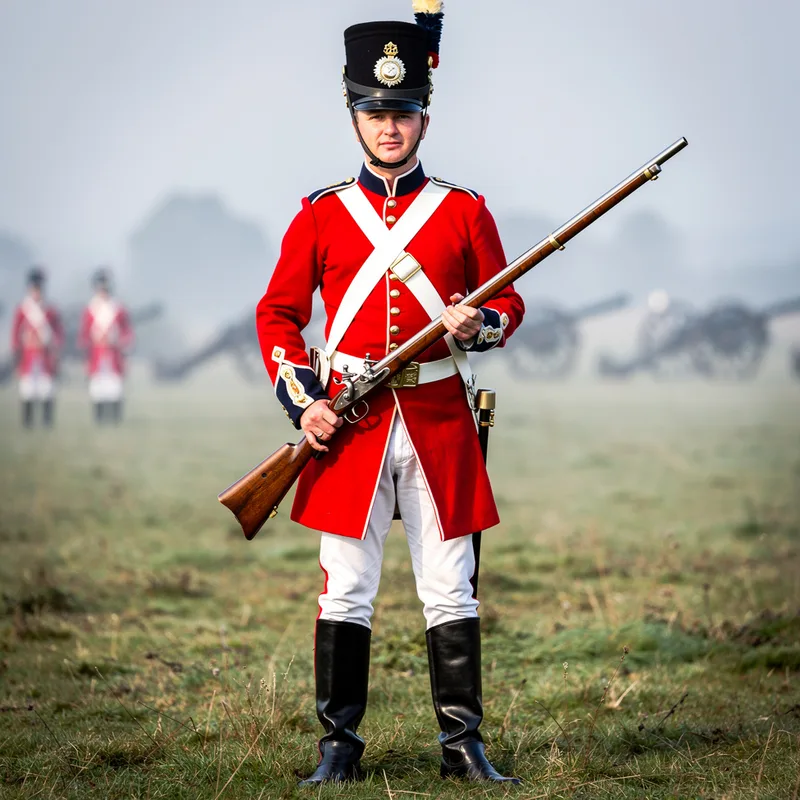
fusilier
 3
9.9
3
9.9

- noun
- /ˌfjʊzɪˈlɪə/
- Archaic
 :
fusilero
:
fusilero
- Historically, a fusilier was known for fighting with a flintlock musket in the British army.
- fusilier battalion
- Royal Fusiliers
- Lancashire Fusiliers
There was frost in the ground when the tigers broke free and no one survived from the Royal Fusilier's companies.
- There was frost in the ground when the tigers broke free and no one survived from the Royal Fusilier's companies.
Examples
-
No, he was in the Fusiliers, he fought at Dunkirk.
-
"But the Fusiliers will never forget," she said quietly.
Fiction book (2000) -
From the Royal Fusiliers Company C.
-
I can't expect you to understand this, but these men belong to the ninth fusiliers.
-
They married while he was at Oxford, but immediately on graduation, in 1915, he took up a commission in the Lancashire Fusiliers.
Fiction book (2001) -
"Corporal John Smalley, Her Britannic Majesty's London Fusiliers," he said.
Fiction book (2002) -
On the outbreak of war, he volunteered for service and was appointed chaplain to the Royal Munster Fusiliers, serving in Western France.
Blog text (22) -
And she's oftentimes been seen sleigh riding with Captain John Andre of the Royal Fusiliers.
Fiction book (1994) -
Major Sylvester Pennington Sloane of Her Majesty's 42nd Highland Fusiliers, retired.
-
The soldier proudly wore the uniform of a fusilier during the ceremony.
Synonyms
 81
9.0
81
9.0
A soldier in the past who used a long gun to fight

A soldier who fights on foot, marching long distances with a heavy pack and gun
Surface Forms
Morphology
Etymology
Fusilier comes from the French fusil, which means a 'small gun' or 'flintlock', and that word came from an old word for 'spindle' because the gun looked long and spindle-like. So a fusilier was originally a soldier who carried a fusil, which is why the name means that kind of soldier.