

fusiform
 1
9.9
1
9.9

- adjective
- /ˈfjuːzɪfɔrm/
- Specialized
- The designer chose a fusiform vase that tapers elegantly at both ends.
Examples
-
Exploration and carpal tunnel decompression of the left wrist with incisional biopsy were performed for the presence of a fusiform swelling intimately associated with the median nerve.
Academic text (2015) -
On physical examination, a soft fusiform mass is often visible and located on palpation.
Academic text (2015) -
Subsequently, the stomach appears as a fusiform dilatation of the foregut, and its appearance changes as various regions of its wall grow at different rates.
Academic text (2007) -
They assume a fusiform appearance without compromising the morphologic or functional integrity of the nerve.
Academic text (2006) -
These tumors are characteristically slow-growing, well-encapsulated, round or fusiform, and closely associated with the nerve of origin, and they are usually solitary and painless.
Academic text (2001) -
Intraoperatively, a fusiform enlargement of the median nerve causing carpal tunnel compression was identified (Figures 2A to 2C).
Academic text (2015) -
The fish has a sleek, fusiform shape that helps it swim quickly through the water.
-
In biology class, we learned that the fusiform form of certain plant cells aids in efficient transport.
Synonyms
 1
4.4
1
4.4
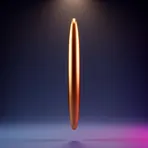
Long and thin with both ends narrower, like a cigar

Narrow at both ends and wider in the middle, like a long thin oval
How Tapered


Surface Forms
Morphology
fusiform = form (semi-transparent) = fusi + form
The suffix '-form' clearly signals 'shape', but the combining element 'fusi-' (meaning 'spindle') is an uncommon combining form that most learners will not recognise.
Etymology
Fusiform comes from the Latin fusus, meaning 'spindle', and the ending -form, meaning 'shape'. So, something fusiform is 'spindle-shaped', wide in the middle and narrowing at both ends.