

funeral march
 1
3.5
1
3.5

- noun
- /ˈfjuːnərəl mɑːrtʃ/
- The Alliance sent other music to member choirs, including Chopin's "Funeral March."
- play a funeral march
Examples
-
The composition ends with a funeral-march theme from Chopin.
Academic text (1999) -
The military band plays a funeral march as the procession moves down the street.
-
The military band plays a funeral march.
-
Plan a funeral march from the temple to South Hill.
Fiction book (1992) -
The band began to play a solemn funeral march.
Fiction book (2002) -
A Sicilian brass band bleats a funeral march.
Fiction book (1991) -
Suddenly, the funeral march sounded from the loudspeakers hanging on the cement poles every few hundred feet in the street ahead.
Fiction book (1992) -
Ana Torroja, the singer, played background music of a funeral march and recited the Latin phrase at the end, 'Finis gloriae mundi homini' ('the end of the glory of the world of man').
Blog text (2) -
During the ceremony, a somber funeral march echoed throughout the hall.
-
As the casket was carried away, the musicians softly played a funeral march.
Synonyms
 10
8.9
10
8.9
A musical piece sung at a funeral to honor the dead
 8
8.2
8
8.2
A slow sad song for people who have died
 8
3.2
8
3.2
A piece of music with a strong, steady beat for bands
 1
7.6
1
7.6
A piece of music played during a formal walk in a ceremony
 1
3.2
1
3.2
Music that people play at a funeral to remember someone, usually slow and sad
 1
3.7
1
3.7
Music with a strong regular beat played by bands for parades

 1
8.8
1
8.8
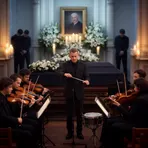
Slow, solemn music played at funerals and memorial services
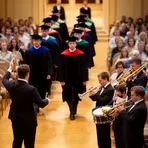
Music with a steady marching beat played during a formal procession
How Solemn

Surface Forms
Morphology
The meaning is directly and transparently derived from combining 'funeral' (a ceremony for the dead) with 'march' (a piece of music with a steady rhythm); together they straightforwardly denote a march used in a funeral procession. This compositional pattern is cross-linguistically common (e.g., Spanish 'marcha fúnebre', French 'marche funèbre'), so a B1 learner who knows both constituents will readily infer the meaning.
Etymology
The noun funeral march comes from two simple images: a march is music with a steady beat for people to walk to, and at a funeral people walked slowly in a 'funeral procession' behind the coffin. Because the music matched those slow, heavy steps, funeral march means 'a slow, solemn piece of music played for a funeral'.