

functional anatomy
- noun
- /ˈfʌŋkʃənl əˈnætəmi/
- Specialized
- As the emphasis in the mechanical approach grew, some faculty with expertise in functional anatomy resisted this newly created balance of knowledge.
Examples
-
Instruction in the introductory "kinesiology" course emphasized functional anatomy since there was little biomechanical research on how human movements were actually created.
Academic text (2003) -
In my biology class, we studied the functional anatomy of the heart to understand how its structure supports its role in pumping blood.
-
A presentation of the functional anatomy of the skin and underlying tissue is required for the reader who is less familiar with the anatomy of the body wall.
Academic text (1995) -
Many biomechanics textbooks retained functional anatomy content, struggling to include the new emphasis on mechanics and application to human movement.
Academic text (2003) -
The vast majority of the competencies are mechanics, with only a few application competencies and functional anatomy clearly identified as prerequisite knowledge.
Academic text (2003) -
The research of that time focused on theories developed from deductive reasoning based on functional anatomy and the earliest studies of sport biomechanics in the United States.
Academic text (2003) -
This approach is effective in introducing the need for biomechanics by reviewing the discovery of complex activation of muscles that often conflicts with the hypotheses of functional anatomy.
Academic text (2003) -
The history of introductory biomechanics instruction is reviewed with regard to the balance between functional anatomy and mechanics and the emphasis on qualitative and quantitative analysis.
Academic text (2003) -
Second, functional anatomy was clearly identified as prerequisite information in the guidelines and standards, so it was easy to de-emphasize the anatomical competencies in favor of newer biomechanical studies and variables.
Academic text (2003) -
By the middle of the 20th century, decades of EMG research had shown that many muscle actions deduced by functional anatomy were often incorrect and could vary across subjects (Basmajian & DeLuca, 1985).
Academic text (2003)
Synonyms

Study of body parts and how they work
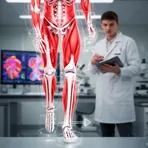
The study of body parts like bones and muscles and how they help the body work
How Functional
- Specialized

- Specialized
- Specialized
 96
3.8
96
3.8

- Specialized
3
7.4
Surface Forms
Morphology
The meaning 'the branch of anatomy that focuses on the relationship between anatomical structure and function' is directly derivable from 'functional' (relating to function) modifying 'anatomy' (study of bodily structures). This adjective+noun composition is a standard, cross-linguistically common pattern, so a B1 learner who knows both constituents can readily infer the MWE's meaning.
Etymology
Functional anatomy combines anatomy, the study of body parts, and functional, which means how those parts work. The idea is to look at a bone or muscle and imagine how its shape helps it do a job, so 'functional anatomy' means studying the link between body shape and 'how parts work'.