
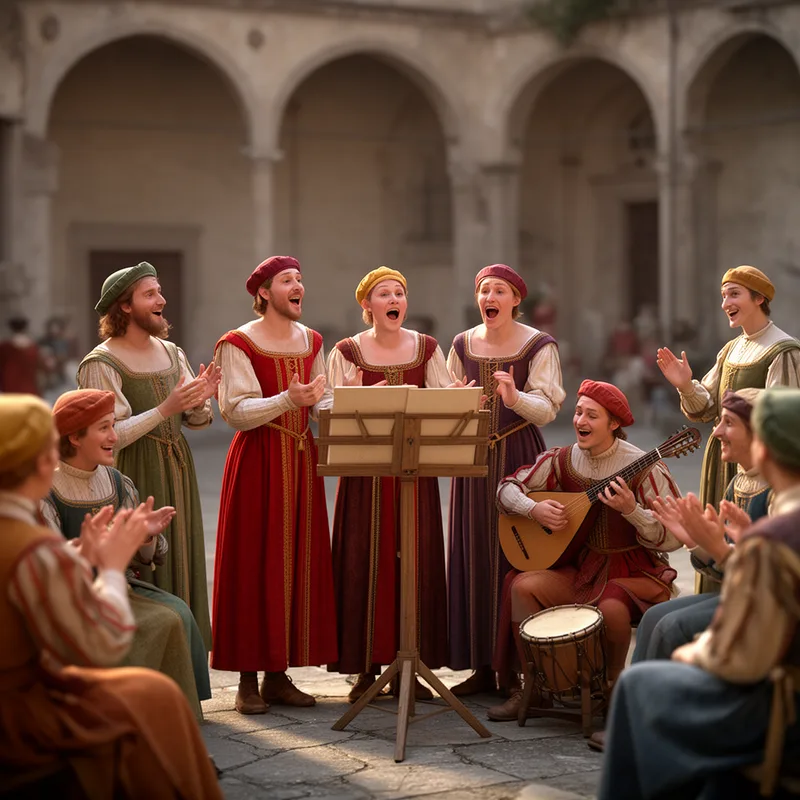
frottola
- noun
- /ˈfrɒtələ/
- Archaic
- The frottola is known for its catchy melodies and was a favorite among Renaissance musicians.
Examples
-
In poem 101, there is a common lexis to that of the frottola and the same theme of the imminence of death, the acknowledgment that love has made one a prisoner, and the compensation derived from "knowing" that one is not deceived.
Academic text (2003) -
If the riddles and proverbs of the canzone-frottola are confusing, they connect at a deeper, more parabolic level.
Academic text (2003) -
These forms, like the frottola form, are appropriate to the declared intention to never sing again as one once did.
Academic text (2003) -
The frottola would remain disordered, and the renunciation of Laura of the descort.
Academic text (2003) -
I agree with Foresti's focus on the I-character's "indifference" toward the love object, and I see it as the necessary starting point, the status quo ante, of his further development, as permitted by the canzone-frottola.
Academic text (2003) -
Pietro Bembo essentially rejected poem 105; although he recognized its formal superiority to another frottola attributed to Petrarch, he denied that it had any sense or logical consequentiality.
Academic text (2003) -
Many composers experimented with the frottola form, creating vibrant and engaging pieces for their audiences.
-
During the late 15th century, the frottola became prominent in Italy, influencing the development of early modern music.
Synonyms
 5
9.9
5
9.9

A song for several voices sung without instruments, often from the Renaissance

A lyrical Italian song or poem from medieval to early modern times

A simple country song or dance from Italy
Surface Forms
Etymology
Frottola was the name for a simple, non-religious song in Renaissance Italy, a short court tune with plain words and an easy melody. That's why frottola today refers to that kind of Italian song form.