
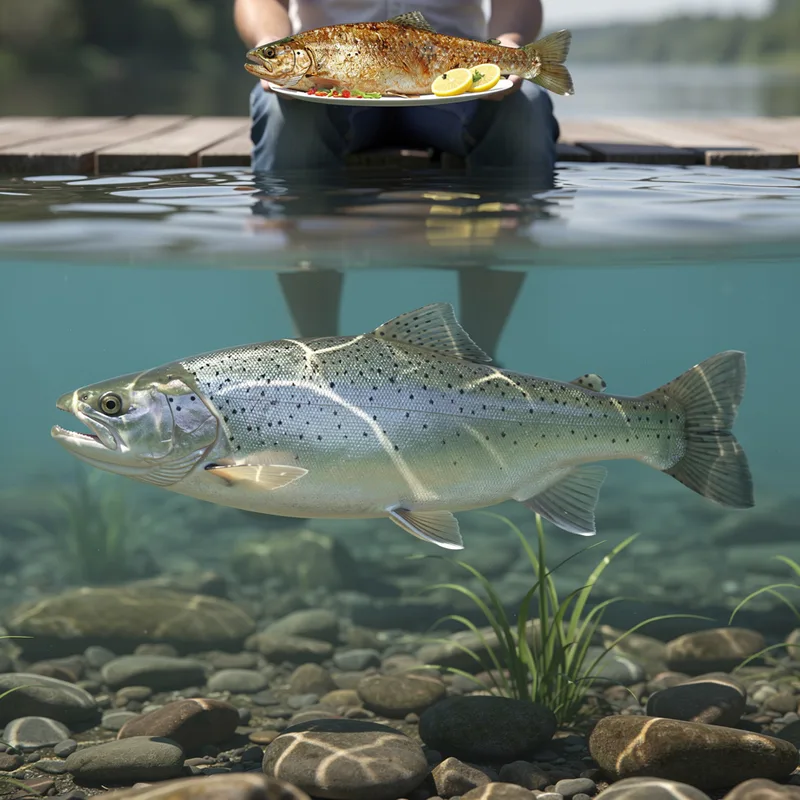
freshwater fish
 3
2.0
3
2.0

- noun
- /ˈfrɛʃˌwɔːtər fɪʃ/
- The seafood restaurant specializes in dishes made from locally sourced freshwater fish.
- species of freshwater fish
- freshwater fish consumption
Examples
-
During our trip, we learned how to prepare freshwater fish in various traditional recipes.
-
Wild brook trout and other freshwater fish have been documented in the region.
Blog text (19) -
Look out for freshwater fish and brown bears in the surrounding hills.
Blog text (31) -
Here, we examine whether sufficient data are available to evaluate the risks and benefits of eating freshwater fish from the Great Lakes.
Academic text (2012) -
The Muskie, king of freshwater fish is best known for its audacious eating habits.
-
Freshwater fishes, by their very nature, are already adapted to life in relatively contained habitats.
Academic text (2005) -
Reduced water flow in the Everglades also affects the numbers of freshwater fish and other aquatic organisms.
Academic text (1994) -
Nicaragua has 100 species of freshwater fish, 200 species of mammals, 600 species of amphibians and reptiles, and 750 species of birds.
Academic text (1990) -
The Apalachicola River has the most remarkable biodiversity of the large rivers of the panhandle, supporting more than 90 species of primary freshwater fish, more than 30 species of mussels, and more reptile and amphibian species than the other rivers.
Academic text (2008) -
The 'ō'opu alamo'o (Lentipes concolor) is one of just five species of freshwater fish native to the Hawaiian Islands.
Academic text (2004)
Synonyms
 805
1.0
805
1.0
Meat from a water animal that people cook and eat
 123
1.0
123
1.0
A freshwater fish like a salmon that people often eat
 60
1.0
60
1.0
A fish with whisker-like feelers often eaten as food
 21
2.4
21
2.4
A large freshwater fish often kept in garden ponds or eaten as food
 10
3.5
10
3.5
A fish with white flesh that people eat

Meat from a large freshwater fish often cooked or smoked

The flesh of a large fish from cold northern lakes that people eat

Meat from freshwater fish eaten as food

A freshwater fish that lives in lakes and people catch to eat

A large freshwater fish kept for food or as decoration, like koi

A fish from lakes and rivers in North America that people catch for food and sport
Surface Forms
Morphology
The meaning is directly and transparently derived from 'freshwater' (non-salty water in lakes and rivers) + 'fish' (fish as food/animals): it denotes fish that live in freshwater and are eaten. This noun–noun compounding pattern is common and predictable across languages, so a B1 learner who knows both constituents will understand the MWE.
Etymology
Freshwater fish names fish that live in fresh (that is, 'not salty') water like rivers and lakes. So, the phrase now also means the fish themselves or their flesh 'eaten as food'.