
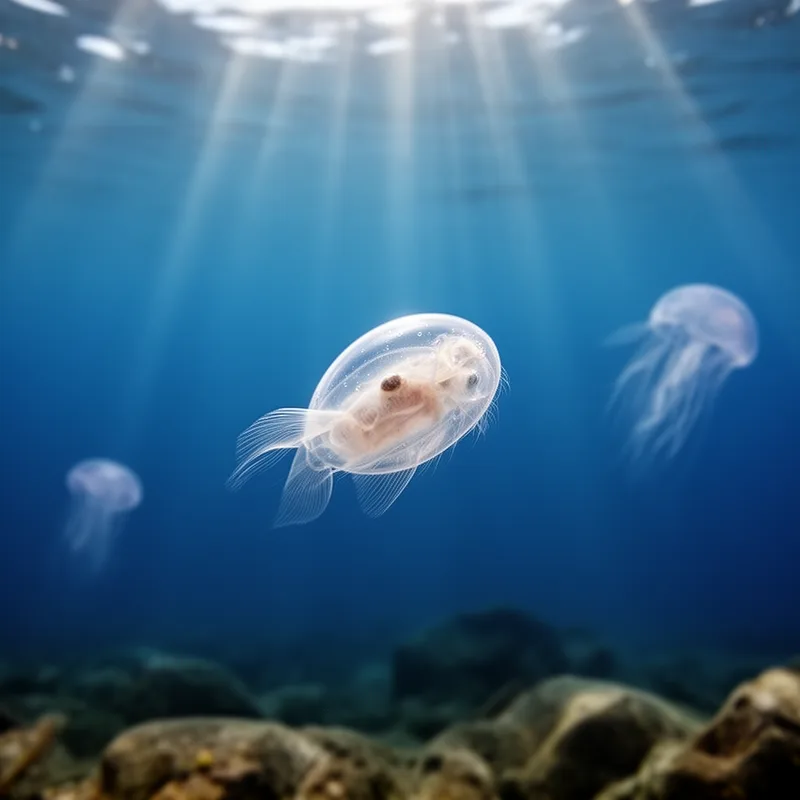
free-swimming


 1
4.4
1
4.4
- adjective
- /friːˈswɪmɪŋ/
- Specialized
- The free-swimming fish darted through the coral reef, exploring their vibrant environment.
- free-swimming schools
Examples
-
Traditionally, when fishing is concentrated in this area, catches are primarily from free-swimming, schooling fish, and at most 20% of the sets are on schools associated with floating objects.
Academic text (1997) -
Infection occurs when the free-swimming larvae of the blood fluke, called cercariae, come into contact with and penetrate the skin of a traveler either swimming or wading in water.
Academic text (2012) -
Approximately 56% of this catch was made on schools associated with floating objects, and 44% on free-swimming schools.
Academic text (1997) -
Adults may also prey on free-swimming fry, at least until they develop spines.
Academic text (1990) -
Because it is a tiny, free-swimming organism, one would expect that T. californicus could be frequently transported by coastal currents among neighboring rocky sites.
Academic text (2009) -
Like other free-swimming protozoans that live in the same habitat, L. clarki is, in turn, readily consumed by larvae of the A. sierrensis mosquito.
Academic text (1992) -
Sherlock and MBARI colleague Bruce Robison happened upon free-swimming Bathochordaeus (without their houses) at depths up to 1,214 meters.
Academic text (2004) -
For fish caught in schools associated with floating objects, the average was 59 cm FL and significantly smaller than fish caught in free-swimming schools (average 83 cm FL).
Academic text (1997) -
"Our decision was to let these wild free-swimming animals behave as naturally as possible, and we certainly acknowledged all along that we couldn't guarantee that all of them would live," says Teri Frady, spokeswoman for the National Oceanic and Atmospheric Administration.
Blog text (24) -
Although free-swimming schools consist of as much as 90 percent yellowfin tuna, the overall average catch for the area is fairly evenly divided between the two species, with skipjack tuna representing 53 percent of the 1988 catch and yellowfin 47 percent.
Academic text (1990)
Antonyms

How Mobile

Surface Forms
Morphology
Etymology
The word free-swimming comes from the simple parts free ('not tied') and swimming ('moving in water'). So it describes animals that can swim around on their own and are not attached to one place.