

foreshore
 1
6.9
1
6.9

- noun
- /ˈfɔrˌʃɔr/
- Erosion of the upper foreshore continues at a rate that greatly exceeds the natural rate.
- the upper foreshore
Examples
-
A village struggled along the foreshore, lights already glimmering into the dusk.
Fiction book (1993) -
They want to meet me on the foreshore by the pub.
-
A boat brings visitors to a strip of sandy foreshore where they can crack a frostie and grab fish and chips while enjoying the fabulous panorama of Sydney Harbour.
Blog text (14) -
Beach users may dislike the coarse, angular sediments, steep foreshore slopes, and high berms that make access difficult.
Academic text (2008) -
The foreshore retreats rapidly as waves and swash rework sediments to adjust the shoreface profile to a gentler upper gradient.
Academic text (1990) -
We enjoyed a peaceful day on the foreshore, collecting shells and watching the waves.
-
The children played happily on the foreshore while their parents set up a picnic.
-
Walking along the foreshore, I observed the tide slowly retreating from the sandy beach.
Synonyms

 1
9.3
1
9.3
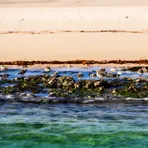
The part of the shore of a sea or lake between high and low water
Surface Forms
Morphology
Etymology
The word foreshore is made of fore- meaning 'before' or 'in front', as in forehead, and shore meaning 'land by the sea', so it refers to the part of the shore that is between high and low tide.